 English
 German
 French
 Spanish
 Portuguese
 Italian
 Polish
 Turkish
 Romanian
 Greek
Greek
 Bulgarian
 Russian
 Arabic
 Hindi
Hindi
Window production machines
Window Production Machines – Key Technology for Modern Window and Door Manufacturing
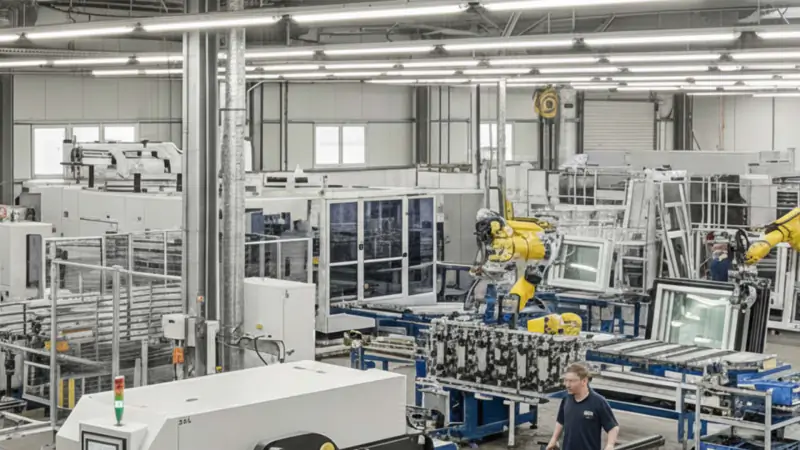
Window production machines are the backbone of economical, precise and permanently CE-compliant window and door manufacturing. Without specialised machines for profile processing, cutting, welding, corner cleaning, hardware installation and glazing, today’s professional production of PVC, aluminium and timber windows would be unthinkable. Those who invest in high-performance window production machines lay the foundation for quality, competitiveness and long-term customer satisfaction.
Evomatec draws on the experience gained from a large number of successfully implemented customer projects to carry out inspections, acceptances and tests of window production machines with the highest level of diligence, clear documentation and strict alignment with all relevant CE safety requirements.
What Are Window Production Machines? Definition and Classification
The term window production machines covers all machines, systems and automation solutions used along the entire value chain in window and door manufacturing. They range from simple mitre saws to highly automated CNC machining centres with integrated handling and logistics solutions.
Typical categories of window production machines are:
- Profile cutting machines such as mitre saws, double mitre saws and underfloor saws
- CNC machining centres for PVC, aluminium and partially timber profiles
- Welding machines and welding lines for PVC window profiles
- Corner cleaning and post-processing machines
- Hardware processing and assembly automates
- Glass and insulating glass lines including glass washing machines
- Handling, conveying and storage technology for profiles, frames and sashes
Modern window production machines combine robust mechanics with intelligent control technology, reliable sensors and a consistent safety concept. They are therefore not only a means of increasing productivity, but also a central building block for reproducible quality, CE-compliant safety and well-documented processes in window manufacturing.
Evomatec considers every machine in the context of the entire production line. In this way, inspections can be systematically planned and implemented so that the CE conformity of each individual machine and of the interconnected overall system is permanently ensured.
Historical Development of Window Production Technology
The history of window production is closely linked to the development of specialised window production machines. In the days dominated by craftsmanship, timber windows were mainly manufactured using classic joinery machines such as circular saws, planers and routers. Industrialisation and the introduction of PVC and aluminium profiles marked the beginning of a new era.
The most important development steps were:
- Introduction of industrially produced PVC and aluminium profiles
- Development of mitre and double mitre saws for precise cutting of frame and sash elements
- Emergence of specialised welding machines for PVC windows
- Automated corner cleaning to improve appearance and reproducibility
- Introduction of CNC machining centres with multiple axes and tool changers
- Connection of machines to planning and ERP systems in line with Industry 4.0
With every technological leap, the demands on safety, documentation and proof of conformity have increased. Evomatec has actively accompanied this change and has a deep understanding of how window production machines must be designed, tested and monitored in operation today in order to comply permanently with the applicable CE requirements.
The Most Important Types of Machines in Window Production
Profile Cutting: Mitre Saws, Double Mitre Saws and Underfloor Saws
The starting point in window production is the precise cutting of PVC and aluminium profiles. Mitre saws, double mitre saws and underfloor saws are used here. They play a decisive in determining the subsequent dimensional accuracy of frame and sash elements.
Key requirements for cutting machines are:
- precise cutting lengths and repeatability
- very good angle accuracy, especially for 45-degree mitres
- clean, burr-free cutting surfaces
- saw blades and feeds optimised for aluminium profiles
- reliable guarding and effective extraction
Through consistent inspection and maintenance concepts, Evomatec helps its customers to keep cutting quality stable in the long term and to operate all safety devices on mitre saws and double mitre saws in permanent compliance with CE requirements.
CNC Machining Centres for PVC and Aluminium Profiles
CNC machining centres form the heart of profile processing. They carry out drilling, milling and slotting operations on frame and sash profiles and largely eliminate the need for manual machining steps.
Typical characteristics of modern CNC window production machines:
- 3-, 4- or 5-axis machining for complex contours
- automatic tool changer for different cutters and drills
- flexible clamping systems for different profile geometries
- parameterisable programmes for different window types
- integration of labelling and identification of profiles
Thanks to extensive project experience, Evomatec knows how CNC machining centres must be designed, documented and tested to ensure that both product quality and CE safety remain at a high level for many years. Inspections are based on structured checklists which consider mechanics, electrics, control technology and safety functions equally.
Welding Machines and Welding Lines for PVC Windows
For PVC windows, welding of the profiles plays a central. Welding machines join the cut profile pieces into stable frames and sashes. Depending on capacity, single-head, two-head or four-head welding machines as well as complete welding lines are used.
Crucial quality criteria are:
- accurate mitre angles after the welding process
- reproducible welding parameters such as temperature, time and pressure
- small and uniform welding beads
- high corner stability and tightness
Evomatec relies on a proven inspection concept, in which both the functional safety and the process quality of the welding machines are evaluated. Thanks to many years of experience in the window industry, Evomatec can ensure that inspections of welding lines are carried out with the utmost care and in full compliance with CE requirements.
Corner Cleaning and Post-Processing Machines
After welding, the corners of PVC window profiles are cleaned and reworked. Corner cleaning machines remove welding beads, machine visible surfaces and ensure uniform contours. CNC-controlled systems enable a high level of repeatability for different profile series.
The quality of corner cleaning has a direct impact on:
- appearance and surface finish of the finished window
- cleanliness of gasket grooves
- dimensional accuracy of hardware and glazing bead interfaces
- market acceptance and complaint rates
During inspections, Evomatec assesses not only the mechanical precision of corner cleaning machines but also the functional safety of guards and controls. This ensures that product quality and CE safety remain consistently high over the long term.
Hardware Processing and Assembly Automation
Windows are complex functional products. Hardware processing is therefore of central importance. Special window production machines carry out drilling, milling and screwing operations for stays, hinges, locking parts and handles. Depending on the requirements, the spectrum ranges from semi-automated stations to fully automatic hardware assembly lines.
Advantages of automated hardware processing:
- high reproducibility of hardware settings
- shortened assembly times
- lower error rates in drilling and screwing
- improved ergonomics for employees
Evomatec integrates these systems into holistic production concepts and ensures that emergency-stop functions, safeguarded areas and interlocks comply with CE requirements. Experience from many projects feeds into standardised inspection concepts that make inspections transparent and traceable.
Glass and Insulating Glass Lines
Glass processing is essential to complete the window. Glass cutting, washing, pressing, gas filling and sealing are demanding process steps. Specialised glass machines and insulating glass lines ensure that thermal insulation, sound insulation and appearance meet the requirements.
Important aspects are:
- clean glass surfaces without residues
- precise spacer positioning
- consistent gas filling and tightness
- safe handling of glass in ongoing operation
With structured test and inspection procedures, Evomatec supports its customers in operating glass and insulating glass lines safely and efficiently and in documenting all CE-relevant aspects in a traceable way.
Handling and Logistics Systems
Between the individual window production machines, handling and logistics systems take over the material flow. Roller conveyors, transport sections, turning stations, buffer fields and storage solutions are often directly networked with the machines.
The challenge here is to design and document the interaction of many components so that the overall system is CE-compliant. In planning and inspection, Evomatec attaches great importance to viewing lines as a whole. This brings interface risks to light and enables inspections to cover all safety-relevant interconnections comprehensively.
Fields of Application and Industries
Window production machines are found in a wide variety of company structures and industries:
- classic window manufacturers focusing on residential construction
- industrial producers for large-scale and commercial projects
- façade manufacturers using aluminium and steel profile systems
- suppliers for system houses and OEMs
- specialists for passive house windows, historic renovation or special shapes
As company size and the level of automation increase, the requirements for documentation, CE conformity and structured inspections also rise. Evomatec understands the characteristics of the various market segments and adapts machine concepts, inspection intervals and inspection scopes to the specific needs of each company.
Technology and Functionality of Modern Window Production Machines
Modern window production machines combine several technical disciplines. Mechanics, electrical engineering, pneumatics, hydraulics, control technology and software interact with high precision.
Key technical features are:
- energy-efficient drive systems with servo technology
- precise guidance systems and backlash-free bearings
- intelligent sensors for monitoring travel distances, pressures and conditions
- user-friendly HMI operating panels with plain-text diagnostics
- interfaces for data connectivity and remote service
Based on the experience from numerous projects, Evomatec knows which technical details make the difference in day-to-day operations. This knowledge flows into the creation of inspection plans that not only cover statutory minimum requirements but also keep typical wear and fault points in view. In this way, window production machines are ensured to operate reliably, safely and economically.
Quality, CE Conformity and Inspections
In window manufacturing, quality and CE conformity are inseparably linked to the machine technology in use. A machine is only considered safe and compliant if its technical design, risk assessment, documentation and labelling meet European requirements and this condition is maintained during operation.
Inspections therefore pursue several objectives:
- ensuring personal safety in and around the machine
- verifying the effectiveness of all safety devices
- evaluating process stability and machining quality
- early detection of wear and potential failures
- documentation as proof of diligence towards customers and authorities
Evomatec develops specific checklists and testing procedures for each type of machine. Based on many years of project experience, every inspection is carried out in such a way that safety functions, CE criteria and quality-defining components are consistently taken into account. The result is a lean but very effective inspection process that supports production instead of hindering it.
Economic Efficiency and Investment Planning
Investments in window production machines have long-term effects on cost structure, production capacity and market position. Careful investment planning is therefore essential.
Key economic indicators include:
- unit costs per window or door
- throughput time and cycle time per production step
- scrap and rework rates
- plant availability and OEE
- personnel input per produced unit
Evomatec supports companies in the selection, dimensioning and configuration of window production machines. By comparing different scenarios (for example manual production versus automation), it becomes transparent which machine concepts offer the best combination of productivity, flexibility and cost efficiency in the long term. Inspection and maintenance costs are realistically taken into account from the outset.
Practical Examples of Typical Machine Configurations
Compact Solution for Small and Medium-Sized Companies
A typical window manufacturer with medium production volumes may work, for example, with:
- a double mitre saw for precise PVC and aluminium cutting
- a compact CNC machining centre for profile processing
- a two- or four-head welding machine
- a corner cleaning machine
- ergonomic assembly stations for hardware installation and glazing
With such a machine park, a wide range of window types can be covered. Evomatec supports this both in layout planning and in defining sensible inspection intervals so that product quality, CE safety and plant availability remain in balance.
Highly Automated Lines for Industrial Production
Large manufacturers and system partners often work with highly automated lines in which several CNC machining centres, welding lines, cleaning machines, hardware assembly units and glass lines are interconnected via handling and logistics systems.
The advantages of such systems are:
- very high output at stable quality levels
- optimised personnel planning
- a high degree of automation and digitalisation
- continuous data collection and traceability
In such projects, Evomatec contributes experience gained from numerous complex lines. Inspections are designed to keep the entire networked system in view, taking into account the CE conformity of the individual machines as well as the safety-relevant interfaces.
Future Trends: Digitalisation, Sustainability and Industry 4.0
The future of window production machines is digital, networked and resource-efficient. Important trends include:
- real-time monitoring of machine conditions and performance data
- predictive maintenance based on sensors and data analysis
- energy-efficient drives and optimised standby concepts
- integration of quality and process data into central systems
- transparent CO₂ and resource balances along the process chain
Evomatec combines these technical developments with practical service and inspection concepts. By evaluating condition data, it becomes clear when a machine should be serviced before an unplanned downtime occurs. At the same time, safety-relevant functions can be checked and documented regularly without unnecessarily interrupting production.
Selection Criteria for Window Production Machines
Selecting suitable window production machines requires a holistic view of company strategy, product range and available resources. Important criteria include:
- planned production volumes and product variety
- share of PVC, aluminium and timber windows
- available floor space and material flow concept
- qualification level of employees
- degree of automation and digitalisation strategy
- service and spare parts concept
Based on these factors, Evomatec develops customised machine and line configurations. The many realised projects provide a clear understanding of which window production machines, in which combination, are the best long-term choice for specific company profiles. At the same time, planning already takes into account how inspections and CE evidence can later be implemented efficiently.
Service, Maintenance and Training
Even the most modern window production machine can only realise its full potential if service, maintenance and training are organised professionally. This includes:
- preventive maintenance plans with clearly defined intervals
- a structured spare parts strategy
- rapid response to faults
- targeted training for operators and maintenance staff
Evomatec relies on clearly structured maintenance and inspection concepts derived from the practical experience of many customer projects. As a result, inspections can be carried out with high precision and efficiency. Operators and maintenance personnel learn how to operate window production machines safely, detect faults at an early stage and implement corrective measures in a targeted manner.
Advantages and Challenges of Modern Window Production Machines
Modern window production machines offer a wide range of advantages:
- significantly higher productivity and capacity
- reproducible quality with tight tolerances
- optimised material utilisation and lower scrap rates
- better ergonomics and reduced physical strain for employees
- improved documentation and proof of compliance
At the same time, new challenges arise:
- higher investment requirements for complex systems
- increasing demands on qualification and training
- greater dependence on software, data and networks
- higher planning effort for inspections and CE documentation
With an experienced partner such as Evomatec, however, these challenges can be turned into clear advantages. Through sound consulting, tailored machine concepts and consistently structured inspections, Evomatec helps companies to fully exploit the potential of their window production machines while sustainably safeguarding safety, quality and CE conformity.
Conclusion: Window Production Machines as a Strategic Investment
Window production machines are more than technical installations. They are a strategic investment in a company’s future viability. Anyone who invests in high-quality, CE-compliant window production machines creates the basis for consistent quality, economical production, reliable delivery times and a strong market position.
Evomatec supports this path with a holistic approach: from analysis and planning through selection and integration of machines to training, service and recurring inspections. Based on extensive project experience, Evomatec can ensure that inspections and tests are always carried out in a structured, careful and standards-compliant manner – an essential building block for lasting success in window and door manufacturing.
FAQ on Window Production Machines
Which window production machines are particularly important when starting industrial window manufacturing
For an entry into industrial manufacturing, a precise double mitre saw, a CNC machining centre for profile processing, a welding machine for PVC window profiles and a corner cleaning machine are particularly important. Complemented by ergonomic assembly stations for hardware installation and glazing, a wide range of window types can already be produced economically.
How often should window production machines be serviced and inspected
The intervals depend on the type of machine, level of utilisation and operating conditions. It is common to combine daily visual checks by operators, regular preventive maintenance by the maintenance department and recurring inspections based on clearly defined checklists. Evomatec develops customised maintenance and inspection concepts that take into account manufacturer recommendations as well as CE requirements and operational needs.
How can you tell if a window production machine is future-proof
Future-proof window production machines feature modern control technology, open interfaces for data connectivity, flexible software, good spare parts availability and the ability to adapt processes to new profile series or product requirements. Evomatec assists in evaluating and selecting such machines and, through structured inspections, ensures that the systems can be operated safely and efficiently over many years.
Why is CE conformity so important during ongoing operation
CE conformity is not only relevant at the time of commissioning; it must be maintained throughout ongoing operation. Changes to machines, wear or disabled safety devices can jeopardise CE conformity. Through regularly tested safety devices, documented inspections and systematic maintenance, Evomatec ensures that window production machines continue to meet safety and legal requirements in the long term.
Free Expert Consultation on Window Production Machines
You are planning a new window production line, would like to modernise your existing manufacturing setup or professionalise your inspection concept for window production machines Then you can benefit from individual, practice-oriented consulting by Evomatec.
Request your free consultation at info@evomatec.de