 English
 German
 French
 Spanish
 Portuguese
 Italian
 Polish
 Turkish
 Romanian
 Greek
Greek
 Bulgarian
 Russian
 Arabic
 Hindi
Hindi
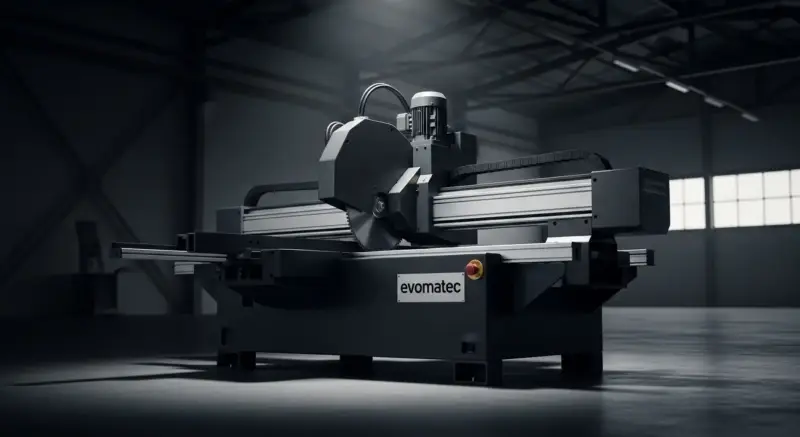
Profile Cutting Machine
Production with a Profile Cutting Machine - Precision, Efficiency, and the Industry 4.0 Transformation
As profile processing operations grow in industry, cutting stops being merely a first step and becomes a decisive quality factor that affects the entire line. When the cut is not correct, tolerance issues, surface defects, and an inevitable increase in scrap occur in the subsequent drilling, milling, assembly, and sealing stages. For this reason, choosing a profile cutting machine today is not just buying a machine; it is establishing a production approach that simultaneously optimizes dimensional accuracy, production speed, operator safety, and total cost.
In this blog post, we will cover the world of profile cutting machines across all critical topics—from workshop scale to factory scale, from manual processes to full automation, and from conventional solutions to an Industry 4.0 profile cutting infrastructure. At the same time, we will position the EVOMATEC approach—highlighting engineering discipline in machine manufacturing and addressing global markets with heavy-duty design and production capability—through real production needs.
Why Profile Cutting Has Become So Critical
Profile production and profile processing have a very wide range of applications across different materials. From window and door systems to façade applications, from structural elements to special extrusion parts, every segment expects millimetric accuracy in cutting. This accuracy does not depend on a single angle; length measurement, clamping force, blade geometry, vibration control, and chip management must be designed correctly at the same time. Therefore, companies searching for both a profile cutting machine and a profile cutting system are, in reality, looking for a system that will “standardize quality.”
When the cutting requirement grows, a flow design comes into focus rather than a single machine. At this point, the concepts of a profile cutting line and a profile cutting production line become prominent. Production is recipe-based according to orders; cut lists are prepared; material is tracked from input to output; inventory, scrap, and time loss are reduced.
Profile Cutting Machine Classes: Automation Level and Production Scale
From Automatic to Fully Automatic: The Language of the Process Changes
As production capacity increases, the operator’s job changes from “cutting” to “managing the line.” In this transformation, the most common options are: automatic profile cutting machine, fully automatic profile cutting machine, and semi-automatic profile cutting machine. In a semi-automatic structure, the operator is more active in loading and some setup steps. In a fully automatic system, the measurement setting, feeding, clamping, cutting, and stacking cycle is carried out with higher integration.
When the scale grows, not only automation but also the control architecture becomes important. For this reason, CNC profile cutting machine and NC profile cutting machine solutions provide flexible programming, repeatable positioning, and better process stability. On the control side, a PLC-controlled profile cutting machine approach makes maintenance and fault management easier in the field and contributes to managing the process in a simple and reliable way.
Workshop Type or Factory Type
Not every business has the same needs. In small-scale production, a workshop-type profile cutting approach offers fast installation, low space requirements, and flexible use. In large-scale production, a factory-type profile cutting setup stands out; here, cycle time, automatic feeding, cut list management, and stacking performance are decisive. When the target grows, an industrial profile cutting machine approach makes the difference with heavy-duty body design and long-term stable operation.
Precision Cutting: The Path to Millimetre Accuracy
Cutting quality is often the result of the system’s overall behavior rather than a single component. For precision profile cutting, length measurement, clamping, blade selection, motor stability, and vibration control must be optimized simultaneously. The path to this goal is not opened by merely using the word “precision,” but by real process engineering. Therefore, a precision cutting machine is evaluated in practice with the following expectations: a high-precision profile cutting machine and the ability to sustain tight tolerances and millimetre accuracy in real production.
The foundation of precision is measurement and positioning. In this context, the concepts of length-measured cutting and measured profile cutting become critical for both quality and repeatability. In practice, this starts with a stop cutting system; in more advanced systems, it continues with a digital measurement system and digital positioning. Instead of manual, error-prone operator adjustment, automatic measurement setting and automatic length setting increase process stability.
Calibration and Continuity
Cutting accuracy must remain the same not only on the first day, but also months later. Therefore, calibration is not a “service task,” but part of the production standard. A design approach that makes calibration discipline easier also provides maintenance convenience and sustainable performance.
Efficiency: Cutting Optimization, Scrap Reduction, and Mass Production
In high-volume production, the main goal is not only to cut fast, but also to reduce total cost through correct planning. At this point, a cutting optimization approach increases the scrap reduction target by arranging the cut list according to material lengths. As production scales up, the goals of high-efficiency profile cutting and mass production profile cutting make every second on the line valuable.
Efficiency shows its true power when combined with planning and traceability. In a programmed cutting logic, each work order is defined with specific parameters. Here, a recipe-based production approach enables fast changeovers using saved settings for different profile types. For management, cut list management becomes critical. On the traceability side, barcode-based production strengthens part, order, and batch tracking.
Feeding and Loading: The Hidden Hero of the Line
Cutting quality is not formed only in the saw unit; how the profile reaches the cutting point, how stable it is transported, and how accurately it is positioned are at least as important as the blade. Therefore, in modern lines, a profile loading system and an automatic profile feeding approach directly affect cycle time and accuracy.
On the feeding side, a servo feeding unit stands out; here, the servo-controlled profile cutting machine logic makes pre-cut positioning repeatable. Depending on the line’s requirements, a roller feeding system or conveyor feeding is preferred. At the part exit, an outfeed conveyor keeps the flow continuous. As production grows, a profile stacking system and automatic stacking reduce operator dependency.
Clamping and Holding: A Design That Defeats Vibration
In cutting, surface quality and tolerance depend on how firmly the part is held during the cut. Therefore, pneumatic clamping solutions are ideal for fast cycles; in applications requiring higher clamping force, hydraulic clamping stands out. Depending on the profile geometry and cutting scenario, a dual clamping system and, in general, a profile clamping system preserve accuracy, especially on long profiles.
Proper clamping also supports the goal of low-vibration cutting. Reduced vibration strengthens the expectation of quiet cutting and extends blade life. The result is more stable cutting quality and a more consistent surface finish.
Cutting Unit: Motor, Spindle, and Saw Head
Cutting performance is about stability as much as it is about power. For this reason, cutting unit design should be considered not only as motor selection, but together with spindle bearing design, rigidity, vibration damping, and safe guarding. In the field, the most discussed components can be summarized as the saw unit, cutting motor, spindle motor, and saw head.
On the blade side, quick blade change is a major advantage for fast maintenance. Blade selection is determined by the material; here, a circular saw blade, a saw blade, and especially a carbide-tipped saw blade—when combined with the correct geometry for materials such as aluminum—strengthen the goal of a smooth cut surface. The right blade and the right clamping provide tear-free cutting and lower burr formation.
Single Head, Double Head, and End Cutting Scenarios
Depending on the application scenario, the most common machine types are divided into a single-head cutting machine and a double-head cutting machine. A single-head structure may be suitable for flexible work; a double-head structure reduces cycle time and strengthens length repeatability by cutting from both ends simultaneously. In practice, this approach brings the advantages of double-head profile cutting and bi-directional cutting into production.
When the end geometry of the profile is critical, profile end cutting and end cutting machine applications come into play. Such applications directly affect assembly quality and joint accuracy.
Angle Cutting and Mitre Cutting
In window, door, and façade applications, angle is a fundamental parameter that determines quality. For this reason, angle cutting system solutions must reliably cover standard 90-degree cutting and common 45-degree cutting needs. Here, mitre cutting quality extends to gap and sealing performance in profile joints. For this purpose, a mitre cutting machine and especially the double mitre cutting concept provide both speed and a quality standard in mass production.
Burr, Chips, and Dust Management: The Standard of Clean Production
Surface quality after cutting is not only a visual issue; it is also decisive in assembly, sealing, and the next processing steps. Therefore, a burr removal system and a burr removal unit support cleanliness at profile ends. For chips formed depending on the material and blade, a chip extraction system, and for finer particles a dust extraction system, keep the production area safe and clean.
Safety: Operator Protection and CE-Compliant Design
In cutting machines, safety is as critical a purchasing criterion as performance. On the guarding and monitoring side, a safety cabin and a protective cover standard separates the operator from direct risks during cutting. In the European market and many global markets, a CE safety approach must be considered from the very beginning of the design.
Active safety components reduce risk in daily use. A safety sensor, a light curtain, and an emergency stop system enable rapid intervention in unexpected situations. The goal of all these elements is clear: operator safety.
The EVOMATEC Approach: Heavy-Duty and High Performance in Machine Manufacturing
The difference in machine manufacturing often appears in the “details”: body rigidity, spindle bearing quality, stability of servo and control systems, and the engineering level of extraction and safety integration. EVOMATEC addresses this perspective not merely as a product promise, but as a system approach. The objective is to increase the balance of cutting capacity, cutting speed, and cutting accuracy while maintaining stable operation in the class of a heavy-duty profile cutting machine.
The on-site reflection of this approach is that the operator makes fewer adjustments and production stops less. On the control side, a PLC-controlled profile cutting machine setup accelerates maintenance and fault management. On the motion side, the servo-controlled profile cutting machine principle strengthens measurement and positioning repeatability. Thus, the goal of tight tolerances becomes more realistic even in high-volume production.
Applications by Material: From Aluminum to PVC
Aluminum Profiles
In aluminum cutting, it is a sensitive balance in terms of surface quality and burr management. For this reason, when evaluating an aluminum profile cutting machine and an aluminum profile cutting system, blade geometry, clamping, and the extraction system should be assessed together. In window and door systems, the need for an aluminum joinery cutting machine is generally associated with mitre cutting accuracy and mass production pace. In extrusion applications, extrusion profile cutting and aluminum extrusion cutting scenarios require feed stability and scrap management on long-length profiles.
PVC, Plastic, and Wood Profiles
In window production, a PVC profile cutting machine and a PVC profile cutting system stand out with expectations of accurate cutting and a clean surface. In plastic applications, a plastic profile cutting machine requires cutting parameters suited to the material’s thermal behavior. In furniture and special applications, a wood profile cutting machine must be configured to preserve surface quality depending on the fiber structure.
Steel and Composite Profiles
In harder materials, steel profile cutting machine and composite profile cutting applications demand higher engineering in terms of power, rigidity, and blade selection. In these areas, heavy-duty class design helps maintain cutting accuracy by controlling vibration and blade deflection.
Application Areas: Windows, Doors, Façades, and Construction
Most cutting applications are concentrated in building systems. For this reason, window profile cutting, door profile cutting, and façade profile cutting operations require angle, surface, and length consistency at the same time. In industrial applications, the need for construction profile cutting may require thicker sections and higher rigidity.
In these application areas, it is not enough for the machine alone to be good; the production flow must also be good. Here, profile manufacturing machines, profile processing machines, and holistically the concepts of a profile production line and a profile processing line come to the forefront.
Control and Digitalization: Data Logging, Remote Service, and Fault Diagnosis
In modern production, every cut is also data. Therefore, a data logging system approach forms the basis for production reporting, quality tracking, and maintenance planning. On the service side, remote service makes it possible to perform many checks without going on-site. In troubleshooting, a fault diagnosis system approach reduces downtime and supports production continuity.
This digitalization is not only software; it is completed with planned maintenance, the right spare parts, and a strong service organization. Therefore, spare parts availability, technical service infrastructure, installation and commissioning quality, and the scope of operator training are decisive in the purchasing decision.
Production Performance: How to Read Capacity, Speed, and Accuracy
When evaluating performance, a single metric is not enough. Cutting capacity shows the overall potential of the production line. Cutting speed directly affects cycle time; however, speed must remain within a range that does not degrade quality. Therefore, cutting accuracy must be read together with speed. A well-designed system preserves cutting quality and the goal of a smooth cut surface even at high speed.
Operationally, manufacturers should track this performance not via “monthly total output,” but via downtime, blade change time, calibration stability, and scrap rate. In this framework, production efficiency belongs not only to the machine, but to the entire process.
Pricing and the Türkiye Market: Setting the Right Expectations
One of the most frequently asked questions in the field concerns profile cutting prices. The correct approach is to evaluate the price not alone, but together with automation level, capacity, safety, digitalization, and service scope. Especially when researching a profile cutting machine price, long-term operating cost and production losses must be taken into account. Due to local access and service dynamics, in searches for a profile cutting machine Türkiye, technical support strength and spare parts organization become even more critical.
A Practical Framework for Choosing the Right Machine
To simplify the purchasing process, you can reduce the decision framework to a few key questions. Does your production type and capacity require workshop-type profile cutting or factory-type profile cutting? Is your product variety high, or do you run mass production of the same profile? Is your angle need continuous; is mitre cutting quality critical? Do you want traceability; do you need barcode-based production and recipe-based production? Do you want to scale the line; is integration with a profile cutting line and a profile processing line targeted?
When you answer these questions clearly, your needs naturally direct you to the right class: an NC profile cutting machine or a CNC profile cutting machine, semi-automatic or a fully automatic profile cutting machine, single-head or a double-head cutting machine. Then the final decision matures with the blade, extraction, safety, and service package.
Establishing Standard Quality with a Profile Cutting Machine
Sustainable quality in production is not coincidence; it is a system job. Choosing the right profile cutting bench and profile cutting workstation addresses measurement, positioning, clamping, blade, extraction, and safety together. Manufacturers that build this structure with strong engineering deliver not only fast cutting in the field, but repeatable quality and high efficiency. From this perspective, the EVOMATEC approach—targeting heavy-duty class in machine manufacturing and combining control and mechanical design at the same standard—aims to make quality measurable and sustainable on the production line.