 English
 German
 French
 Spanish
 Portuguese
 Italian
 Polish
 Turkish
 Romanian
 Greek
Greek
 Bulgarian
 Russian
 Arabic
 Hindi
Hindi
Window Machine
Window Machine – Modern Machines for Industrial Window Production
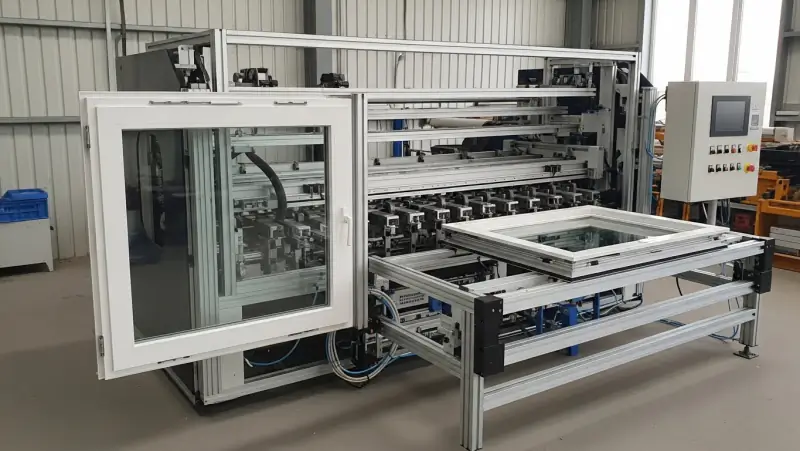
Window Machine is a modern umbrella term for fully and semi-automated machines and production lines used in industrial window manufacturing. It covers everything from individual profile cutting saws and CNC machining centers for window profiles to complete window production lines with welding, corner cleaning, glazing and logistics. In an environment shaped by rising quality expectations, tight delivery times and skilled labour shortages, a well-designed Window Machine concept has become a key success factor for window, door and façade manufacturers.
Instead of isolated stand-alone machines, contemporary Window Machine solutions form a connected system that links mechanical technology, intelligent software and safe material flow. Evomatec supports companies in planning, selecting and implementing such window production machines in a way that is technically robust, economically efficient and prepared for future demands. Thanks to long-standing experience from numerous customer projects, Evomatec is able to structure inspections and machine assessments with exceptional care so that both quality and CE-compliant safety are always reliably ensured.
Understanding the Concept of Window Machine
The term Window Machine is used internationally in the context of professional window production. It typically includes:
machines for cutting and mitre cutting of window and door profiles
CNC machining centers for drilling, milling and slotting
PVC welding machines and corner cleaning machines
insulating glass production equipment and glass handling technology
automated material handling, buffers and transport systems
software and control technology for window production
A Window Machine can therefore be a single, highly specialised window machine or an integrated production line that covers the entire process from raw profile bars to fully glazed elements. Related expressions include window production machines, window manufacturing machines, window construction machinery and window production lines.
What all these concepts share is the focus on efficient, repeatable and high-quality production of windows, doors and façade elements using automated or semi-automated equipment. In practice, a Window Machine concept always has to be adapted to profile systems, order structures, lot sizes and the strategic positioning of the company.
Historical Evolution of Window Manufacturing Machines
From manual craftsmanship to industrial production
For centuries, windows were produced almost exclusively in manual craftsmanship. In joinery shops, wooden frames were cut, jointed and fitted by hand. Production volumes were low, delivery times long, and quality depended heavily on the skills of individual craftsmen.
With industrialisation, the picture began to change. Standardised wooden profiles, steel and later aluminium and PVC profile systems made it possible to introduce more efficient production methods. At first, simple circular saws, planers and drilling machines supported the work. Yet the process still consisted largely of manual, isolated steps.
The rise of automated window production
With the introduction of profile systems specifically designed for industrial window production, the foundations for modern Window Machine technology were laid. Key milestones were:
profile-optimised double mitre saws for frame and sash cutting
mechanical and later CNC-controlled copy routers and machining centers
PVC welding machines and automatic corner cleaning machines
insulating glass lines and specialised glass handling equipment
At first, these machines were standalone units. Over time, they were increasingly networked – mechanically via conveyor systems and buffer stations, and digitally via control and planning software. Today, a high-performance Window Machine concept is characterised by the fact that all process steps are viewed and optimised as an integrated value chain.
Growing importance of safety and CE compliance
Parallel to technical progress, legal and normative requirements increased. The Machinery Directive, standards for electrical equipment of machines and specific regulations for window and façade products led to higher safety expectations for every Window Machine. Modern solutions must therefore combine productivity with proven, documented safety.
This is exactly where experienced partners like Evomatec add value. Because the company has successfully implemented many projects worldwide, its experts know how to design inspections so that high production quality and CE-compliant machine safety are ensured with great thoroughness, not only on day one but throughout the entire machine life cycle.
Technical Architecture of Modern Window Machine Systems
Mechanical design and stability
The mechanical structure is the backbone of any Window Machine. It has to withstand high forces, guarantee precise positioning and keep vibrations as low as possible. Typical design features are:
rigid welded steel frames and portal structures
high-quality linear guides and recirculating ball screws
carefully dimensioned bearings for saw blades and spindles
solid profile supports and clamping systems
In profile cutting, even small angular deviations can lead to visible gaps or sealing problems in the finished window. In CNC machining of aluminium or PVC profiles, insufficient rigidity can cause chatter marks and dimensional deviations. A professionally designed Window Machine therefore always combines robustness with precision.
Drive technology and motion control
Modern window machines use different drive types depending on the application:
servo drives for axes requiring high dynamics and positioning accuracy
frequency-controlled motors for saw blades and milling spindles
pneumatic and hydraulic drives for clamping and feeding functions
In advanced Window Machine concepts, all movements are coordinated via CNC or NC control systems. Multi-axis interpolation, tool compensation and optimised motion profiles ensure fast yet gentle processing of window profiles.
Control systems, software and connectivity
The control system is the “central nervous system” of a Window Machine. Its tasks include:
managing all axis movements and machining sequences
providing a user-friendly operator interface
communicating with higher-level systems (ERP, window design software)
logging production and machine data
Increasingly, Window Machine solutions are connected to digital planning and optimisation tools. Order data can be imported directly from window design software, cutting plans are calculated automatically and transferred to saws and machining centers, and each profile bar is traceable via barcodes or labels.
Evomatec deliberately focuses on open, industry-proven control technologies and interfaces to ensure that Window Machine installations can be smoothly integrated into existing IT structures. This reduces manual data transfer efforts and minimises sources of error.
Safety engineering and CE compliance
Safety technology is not an add-on but an integral part of any Window Machine. Important components are:
guards and protective hoods on sawing and milling units
light curtains, safety fences and access control systems
emergency stop circuits and safe control components
documented risk assessments and CE conformity declarations
To ensure that these measures function correctly over the long term, regular inspections and safety checks are essential. Drawing on a broad portfolio of realised projects, Evomatec has developed structured inspection concepts that systematically verify all relevant safety functions and documentation. As a result, inspections and periodic checks are carried out with a high degree of diligence in terms of product quality and CE-compliant operational safety.
Process Workflow: From Profile Bar to Finished Window
Profile cutting and mitre cutting
Every Window Machine process begins with profile cutting. Long profile bars in PVC, aluminium or hybrid materials are cut to length and mitred. Depending on the production structure, this step uses:
manual or semi-automatic mitre saws
double mitre saws with programmable angles
fully automatic saw lines with NC length stops and magazine loading
Well-designed cutting technology is crucial for later process steps. Clean cuts with exact angles, minimal burrs and optimised offcuts form the basis for precise welding or mechanical connection.
CNC machining of window profiles
After cutting, the profiles are machined on CNC centers. Typical operations include:
drilling and milling for hardware fixing
routing of slots and channels for locking systems
creation of drainage and ventilation openings
special machining for wiring or sensor technology
High-performance window machining centers can work on several sides of a profile in a single clamping operation. Tool changers with multiple tools, automatic profile recognition and parametric machining programs enable flexible yet efficient processing of a wide range of profile systems.
PVC welding and corner cleaning
In PVC window production, welding and corner cleaning are central process steps:
welding machines join the mitred profile ends under pressure and temperature
welding parameters are stored and retrieved according to the profile type
corner cleaning machines remove excess welding beads and finish the corners
Automated Window Machine lines often combine welding stations with buffer systems and robotic handling. This ensures consistent weld quality and high throughput. Evomatec uses experience from many PVC production lines to design welding and cleaning concepts that are both efficient and stable in the long term.
Glass production, glazing and final assembly
In many factories, the Window Machine concept also includes glass production and handling:
glass cutting tables and breakout equipment
glass washing machines and insulating glass lines
handling equipment for safe glass transport
glazing stations with ergonomic workstations
Once frames and sashes are prepared and glass units are available, hardware is fitted, seals are installed and glazing is completed. Final inspection, labelling and packaging complete the process chain.
Key Machine Types within a Window Machine Line
Profile cutting saws and double mitre saws
Cutting technology is always a key element of Window Machine solutions. Application-oriented options include:
single-head mitre saws for flexible craft production
double mitre saws for industrial cutting of frame and sash profiles
automatic saw lines with infeed magazines and outfeed conveyors
High-precision angle adjustment, robust clamping and suitable cutting parameters for PVC and aluminium ensure clean cuts and excellent fit of the finished window.
CNC machining centers for window profiles
CNC window machines are the technological core of many Window Machine concepts. They are responsible for:
multi-side machining of complex profile geometries
fully automatic tool changes with tool libraries
fast program change for different systems and variants
The flexibility of these machining centers is particularly important when a company has to process different window systems, door constructions and façade elements on the same line.
PVC welding and corner cleaning machines
For PVC window manufacturers, welding and corner cleaning machines are indispensable:
two- or four-head welders for frame and sash production
automated corner cleaning machines for visible and invisible surfaces
integrated data exchange with upstream cutting and downstream logistics
Regular, professional inspection of these machines is critical. Based on extensive project experience, Evomatec aligns welding and cleaning inspections in such a way that both process quality and safety-related aspects are scrutinised in depth, ensuring CE-compliant operation over many years.
Glass processing machines and insulating glass lines
Where glass production is integrated into the Window Machine concept, additional machines are used:
glass cutting and breaking systems
vertical or horizontal glass washing machines
insulating glass assembly and gas filling systems
sealing and spacer application equipment
These systems must interact smoothly with the frame production line to avoid bottlenecks and ensure a continuous flow of material.
Material handling, buffers and internal logistics
Finally, the material flow must be organised so that the Window Machine can actually reach its performance potential. Conveyor systems, buffer stations, storage racks and transport trolleys help to:
prevent congestion between process steps
reduce manual lifting and carrying
provide clear order and routing across the factory
Evomatec deliberately considers machines, logistics and software as a whole when designing Window Machine projects, which results in stable, transparent and scalable production processes.
Applications and Industries for Window Machine Solutions
Window and door manufacturing
The core application is of course the production of windows and doors from PVC, aluminium, wood-aluminium and – in special cases – other materials. Window Machine solutions must support:
residential and commercial window production
entrance doors, balcony doors and sliding systems
various performance classes in terms of thermal and acoustic insulation
Small and medium-sized manufacturers benefit from flexible and modular machine concepts, while larger industrial producers often require highly automated lines with high throughput.
Façade construction and metal construction
In façade and metal construction, Window Machine technology is used for:
curtain wall systems and mullion-transom facades
point-fixed glass façades and large-format element façades
sophisticated aluminium and steel constructions
Complex profiles, large dimensions and stringent quality requirements make high-quality machines and carefully planned processes indispensable. Evomatec supports metal construction companies in selecting and configuring Window Machine concepts that meet these specific demands.
Conservatories, modular construction and special applications
Additional application areas are:
conservatories and terrace roofs
modular and container construction
special security or sound insulation windows
project-specific large series for housing developments or public buildings
Here, flexibility and customisation capacity of the Window Machine are particularly important. Production concepts must be able to handle both standard and special elements economically.
Quality, Inspection and CE-compliant Safety
Quality assurance in window production
Quality in window production goes far beyond dimensional accuracy. It includes:
air tightness and driving rain tightness
heat and sound insulation properties
long-term durability of hardware and surfaces
visual quality of welds, corners and glass joints
A modern Window Machine therefore integrates quality assurance measures directly into the production process: from defined measuring points to structured final inspection.
Inspection concepts and CE compliance
Inspections are a central element in ensuring safe and reliable operation of window production machines. They focus on:
mechanical condition (guides, spindles, saw blades, clamping systems)
electrical safety (cables, cabinets, potential equalisation)
safety technology (light curtains, guards, emergency stop circuits)
documentation (risk assessment, operating instructions, CE declaration)
Evomatec has developed comprehensive inspection concepts on the basis of many different installations. This accumulated practical experience enables the company to conduct inspections and periodic checks with particular thoroughness regarding both product quality and CE-compliant machine safety, keeping risks for operators and investors transparently under control.
Economic Aspects: Costs, Efficiency and Return on Investment
Investment costs and operating costs
A Window Machine represents a significant investment. Relevant cost components include:
purchase price of machines and periphery
installation, commissioning and training
maintenance, spare parts and energy consumption
software licences and updates
However, operating costs over many years often outweigh the initial investment. Efficient Window Machine concepts therefore always consider the total cost of ownership: energy efficiency, tool life, maintenance intervals and machine availability.
Productivity gains and payback period
Productivity gains are the key driver in the economic evaluation of Window Machine investments. Typical effects are:
higher output with the same number of employees
reduction of rework and scrap
shorter throughput times from order to delivery
These factors influence the payback period of the investment. With correct dimensioning and consistent utilisation, Window Machine projects can achieve attractive returns. Evomatec supports customers in developing realistic business cases and in selecting machine concepts that fit their strategy and order structure.
Implementation Strategies and Project Planning with Evomatec
From requirements analysis to concept design
A successful Window Machine project starts with a precise understanding of the initial situation and objectives:
current machinery and existing bottlenecks
target capacities and product range
order structure, lot sizes and degree of customisation
available space and infrastructure in the factory
On this basis, Evomatec develops a tailored concept that defines machine types, layout, material flow and integration into the existing organisation. Practical experience from many projects ensures that theoretical planning is combined with realistic implementation paths.
Installation, commissioning and training
During installation and commissioning, careful coordination is essential to avoid long production downtimes. Typical steps are:
mechanical and electrical installation
connection to power, compressed air and IT infrastructure
test operation and trial production
training of operators and maintenance personnel
Because Evomatec teams have accompanied many similar projects, they can plan and execute commissioning processes in such a way that inspections, acceptance tests and CE conformity checks are carried out with a high level of detail and with strong emphasis on safety and quality.
Service, maintenance and long-term optimisation
After commissioning, continuous support becomes important. This includes:
scheduled maintenance and wear part replacement
remote diagnostics and troubleshooting
software updates and function expansions
periodic inspections and safety checks
Using knowledge gained from a broad range of customer projects, Evomatec can propose service concepts that keep Window Machine performance at a high level over many years and systematically reduce unplanned downtime.
Trends and Future Perspectives in Window Machine Technology
Digitalisation and production
Digitalisation is increasingly shaping the field of window production machines. Key developments are:
deeper integration of Window Machine systems into ERP and MES environments
automatic feedback of production data and quality information
dashboards for energy consumption, output and OEE indicators
predictive maintenance based on sensor data
This makes factory operations more transparent and enables management decisions based on real-time information.
Automation, robotics and flexible production cells
Automation levels continue to rise in window production. Future-oriented Window Machine concepts use:
robots for loading and unloading machines
automated storage and retrieval systems for profiles and glass
flexible manufacturing cells that can be reconfigured quickly
The goal is not automation for its own sake, but improved productivity, higher quality and reduced ergonomic strain on employees.
Sustainability and energy efficiency
Energy efficiency and sustainability are gaining importance in all industrial sectors, including window and façade production. Window Machine suppliers respond with:
energy-efficient drive technology and motors
optimised compressed air and vacuum systems
intelligent standby and shutdown concepts
long-lasting, easily maintainable machine designs
Windows themselves play a major in the energy efficiency of buildings. A stable, high-quality Window Machine concept therefore contributes directly to achieving climate targets.
Practical Examples and Use Cases
Upgrading a medium-sized PVC window manufacturer
A typical use case is a medium-sized PVC window manufacturer that wants to increase capacity and quality while remaining flexible. A possible Window Machine solution includes:
one high-performance double mitre saw for cutting frames and sashes
a CNC machining center for profile machining
a four-head welding machine with downstream corner cleaning
streamlined material flow with conveyors and buffers
Here, Evomatec would accompany the project from analysis to commissioning and structure all inspections and safety checks so that maximum quality and CE-compliant safety are assured during operation.
Modernisation of an aluminium façade production
Another example is a metal construction company focusing on aluminium façades. The company might invest in:
a long-bed saw with NC positioning system
a multi-axis CNC center for mullion-transom profiles
logistics solutions for long, heavy profiles
integration into design and calculation software
In such projects, inspection and documentation of the Window Machine components are particularly important, as façade elements are often used in safety-relevant building areas. Evomatec can use its extensive project experience to ensure that all inspections are carried out with a very high degree of precision in terms of both quality and CE conformity.
Advantages and Disadvantages of High Automation in Window Production
Advantages of advanced Window Machine automation
higher throughput and better utilisation of labour
reproducible quality and reliable dimensional accuracy
reduced error rates and fewer complaints
improved working conditions and ergonomic relief
Disadvantages and challenges
higher investment costs and planning effort
increased complexity in maintenance and troubleshooting
greater dependence on stable IT and control systems
need for continuous training of staff
A balanced Window Machine concept therefore always weighs automation level against complexity and the specific situation of the company. Evomatec helps to find a suitable balance in each case.
Conclusion: Building a Future-Proof Window Machine Strategy
Window Machine is more than just the sum of individual machines. It is a holistic concept for efficient, safe and high-quality window production. Companies that strategically plan and implement their window production machines can:
increase productivity and profitability
stabilise and improve product quality
build a scalable basis for future growth
meet legal and normative requirements safely
Experience shows that the success of such projects depends heavily on professional planning, reliable technology and consistent quality and safety management. With its many years of experience across numerous customer projects, Evomatec is in a position to design inspections, acceptance tests and service concepts in such a way that both quality and CE-compliant machine safety are continuously safeguarded at a high level.
FAQ about Window Machine
What is a Window Machine?
A Window Machine is a machine or integrated production line used for industrial manufacturing of windows, doors and façade elements. It includes cutting saws, CNC machining centers, PVC welding and corner cleaning machines, glass processing equipment and material handling systems.
Which industries use Window Machine solutions?
The main users are window and door manufacturers, façade and metal construction companies, conservatory builders, modular building companies and specialised manufacturers of security or high-performance windows. Wherever windows, doors and façade elements are produced in a professional way, Window Machine concepts are relevant.
Why are inspections and CE compliance so important for Window Machine?
Window production machines belong to the category of industrial machinery and must comply with the Machinery Directive and other safety standards. Structured inspections help to detect wear and defects early, reduce accident risks and ensure that the Window Machine can be operated safely and in a legally compliant way over many years. With extensive experience from many installations, Evomatec designs these inspections to be both thorough and efficient, so that quality and CE-compliant safety go hand in hand.
How can Evomatec support my company with Window Machine projects?
Evomatec supports customers along the entire life cycle of a Window Machine: from analysis and concept development through installation and commissioning to training, service and periodic inspections. The practical experience gained from many projects enables solutions that are technically sound, economically viable and consistently aligned with quality and CE-compliant safety requirements.
Kostenlose Beratung anfordern unterwww.evomatec.com