 English
 German
 French
 Spanish
 Portuguese
 Italian
 Polish
 Turkish
 Romanian
 Greek
Greek
 Bulgarian
 Russian
 Arabic
 Hindi
Hindi
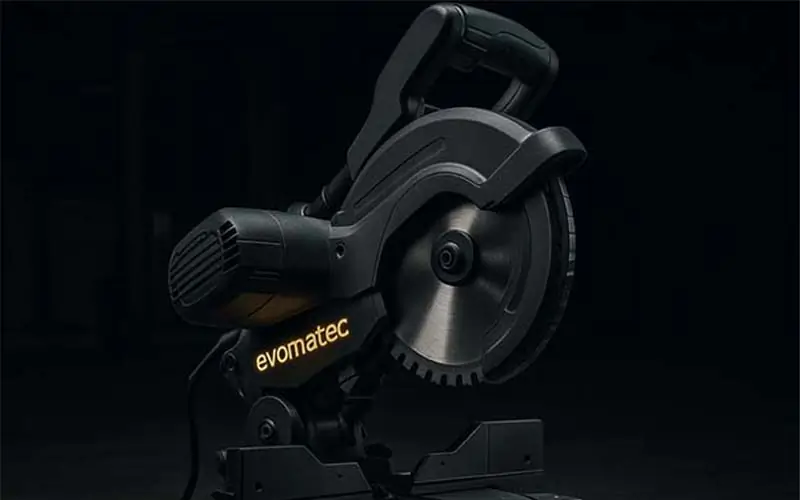
Miter Saw
Mitre Saw – Precision and Efficiency for Professional Cutting
The mitre saw is one of the central tools in modern workshops and production plants when it comes to precise cutting of wood, metal, aluminium, plastic and composite materials. Whether in skilled trades, industrial series production or demanding interior fit-out: A professionally designed mitre saw determines the dimensional accuracy, repeatability and economic efficiency in daily operation. An experienced system partner such as Evomatec supports companies in integrating mitre saws into holistic, CE-compliant production concepts – from machine selection and installation through to inspection and documentation.
Thanks to our many years of experience in numerous customer projects, we can ensure that inspections, acceptances and examinations of mitre saws are always carried out with the highest focus on quality, process reliability and compliance with all relevant CE requirements.
What is a mitre saw? Definition, application and differentiation
A mitre saw is usually a stationary or semi-mobile circular saw that is specially designed for crosscutting workpieces. “To crosscut” means shortening a workpiece to a specific length, often at right angles, but also at mitre or bevel angles.
Typical features of a mitre saw:
Rotating circular saw blade with a defined cutting line
Pivoting saw unit for setting mitre angles
Optionally tiltable saw blade for compound cuts
Stop systems for repeat-accurate length settings
Clamping and safety devices for secure holding of the workpiece
Distinction from other saws:
A table saw is primarily used for rip cuts and formatting panels or boards.
A mitre saw without sliding function is often limited to smaller workpieces and simple mitres.
The mitre saw with sliding function (sliding mitre saw) combines precise angle cutting with high cutting capacity in width.
In practice, terms such as mitre saw, compound mitre saw, sliding mitre saw or cut-off saw are often used synonymously. For SEO optimisation, it is advisable to use these variants within the text in order to achieve broad search coverage.
Historical development of the mitre saw – from hand cuts to automated systems
The history of the mitre saw begins with simple hand saws and mitre boxes, where the craftsperson clamped the workpiece in a template and guided it with a hand saw. With industrialisation, stationary circular saws were introduced to enable faster and more consistent cutting.
Over time, specialised crosscut saws were developed, in which the saw blade is guided from above into the workpiece. With the advancement of machine technology, precise pivoting units were added, making mitre and bevel cuts possible.
Milestones in the development:
Introduction of carbide-tipped saw blades for longer tool life and improved cut quality
Development of the sliding mitre saw, in which the saw unit is guided on rails and pulled forward
Integration of digital angle displays and length measuring systems
Transition to CNC-controlled, automated crosscut systems in industrial series production
In parallel, safety and standards requirements have evolved significantly. Modern mitre saws today must meet strict guidelines to be operated in a CE-compliant manner. Here, Evomatec supports numerous companies in selecting appropriate machine technology, in carrying out risk assessments and in professional inspection of the systems. Thanks to this project experience, inspections can be structured in such a way that safety and quality remain at a consistently high level.
Design and operating principle of modern mitre saws
Saw blade and drive
The saw blade is the central element of the mitre saw. Diameter, tooth form, rake angle and material determine which materials the blade is optimised for and which cutting quality can be achieved.
For wood and wood-based materials, large-toothed carbide blades are often used.
For aluminium and thin-walled metal profiles, fine-toothed blades with special tooth geometries are used.
For plastics, saw blades are used that minimise tear-out and reduce thermal loads.
The drive is provided by robust electric motors with sufficient power reserves to ensure stable torque and constant speeds even under continuous series production. In industrial concepts, the mitre saw is integrated into a coordinated energy concept in order to ensure efficiency and process stability.
Mitre and bevel adjustment
A classic compound mitre saw allows the saw unit to swivel in the horizontal plane to cut mitre angles. In addition, the saw blade can often be tilted vertically, enabling complex compound cuts (for example in roof constructions or frame joints).
Important aspects:
Precise scales with clearly legible angle graduations
Detent positions at frequently used angles (for example 0°, 30°, 45°)
Backlash-free mechanics to minimise angular errors
In industrial applications, angle specifications can partly be retrieved digitally, via control systems or using pre-programmed cutting programs. Integration into higher-level systems is a central topic here, where Evomatec as a system provider brings in extensive experience from real-life applications.
Sliding function and cutting capacity
The sliding mitre saw significantly increases cutting capacity in width. While a classic mitre saw is limited by its fixed pivot point, the sliding mechanism allows the saw unit to move along guide bars and thus process wide workpieces such as panels, decking boards or wide profiles.
Key features:
High-quality, backlash-free guides
Smooth running without vibrations for clean cutting edges
Clear cutting line marking (for example by laser or shadow line)
Safety and protection systems
Safety plays a central with every mitre saw. Typical safety devices include:
Transparent blade guard above the saw blade
Mechanical hold-downs and clamping devices
Emergency stop switches and interlocking systems
Connection for extraction systems to reduce dust and chips
In CE-compliant systems, a detailed risk assessment is carried out that considers movements, accessibility and possible operator errors. Evomatec supports these processes from planning through to final inspection, placing great importance on the fact that every inspection is carried out with maximum care in terms of CE safety, occupational safety and product quality.
Fields of application and industries for mitre saws
Wood and furniture production
In woodworking, the mitre saw is an indispensable tool. It is used for:
Crosscutting boards, mouldings and beams
Cutting furniture components to length
Trimming skirting boards, ceiling profiles and decorative mouldings
Producing frames, casings and structural elements
Thanks to precise mitre functions, clean, tight corner joints can be produced that are convincing both visually and structurally.
Window, door and façade construction
In window, door and façade construction, mitre saws are used for wood, plastic and aluminium profiles. Typical applications:
Cutting window and door frame profiles to length
Mitre cuts for clean corner joints
Cutting substructures for façade systems
Here, the mitre saw is often combined with other processing steps, such as drilling, milling or welding. Evomatec implements complete production concepts in which mitre saws, milling machines and machining centres are optimally matched to one another. Inspection of such complete systems is carried out on the basis of well-proven checklists, ensuring that quality and CE-compliance are verifiable at all times.
Metal and aluminium profile processing
An industrial mitre saw for metal and aluminium usually operates with adjusted speeds and appropriate cooling and lubrication concepts. Applications:
Cutting aluminium profiles in façade construction
Crosscutting steel or light metal profiles in metal construction
Processing profiles for mechanical and plant engineering
Especially in the field of aluminium profiles, high demands are placed on cutting quality, as downstream processes such as coating, powder coating or assembly can only be carried out efficiently with clean, low-burr cut surfaces.
Interior fit-out, exhibition and shopfitting
In interior fit-out, exhibition and shopfitting, flexibility is essential. A professional mitre saw must handle quick set-ups, frequent angle changes and varying materials. Typical tasks:
Cutting decorative mouldings, panels and frames
Adapting components directly on site
Producing precise corner joints for counters, furniture and wall claddings
Types of mitre saws – from workshop machine to industrial system
Simple mitre saw
A simple mitre saw without sliding function is particularly suitable for right-angled and mitre cuts on narrower workpieces. It is common in smaller workshops and often serves as a basic machine.
Compound mitre saw
The compound mitre saw enables both right-angled and angled cuts. It is universally applicable and is found in carpentry shops, joineries, metalworking companies and everywhere else where precise angle cuts are required.
Sliding mitre saw
The sliding mitre saw combines the advantages of a compound mitre saw with increased cutting capacity. It is particularly attractive when wide panels, parquet boards or profiled boards are frequently cut to length.
Stationary industrial mitre saw
Stationary, industrial mitre saws are robustly constructed machines with high power, automatic clamping technology and integrated angle setting. They are usually installed permanently at a fixed workstation and designed for high output quantities.
Automated crosscut systems
In fully automated crosscut systems, the mitre saw is supplemented by feeding systems, length measuring systems and intelligent controls. Typical features:
Automatic separation and positioning of material
Measuring systems for precise cutting with optimised waste reduction
Connection to production planning systems (for example cutting optimisation based on part lists)
Evomatec implements and supports such system projects in various industries. The comprehensive experience from many installations and inspections makes it possible to design automated crosscut systems in such a way that both product quality and CE-compliant safety concepts are taken into account from the outset.
Quality criteria and selection of a mitre saw
Cut quality and repeatability
A professional mitre saw is characterised by smooth, low-tear cut surfaces and high dimensional and angular accuracy. The decisive factors are:
Precise guidance of the saw unit
Low-play bearings and guides
High-quality saw blades
Stable machine table and solid stops
Ergonomics and operating comfort
For daily use, ergonomic design of the mitre saw is essential:
Easily accessible operating elements
Clear scales and displays
Safe, intuitive clamping devices
Low physical strain when repeating identical hand movements
CE compliance and standards
Every industrial mitre saw must meet the requirements of the relevant machinery directives and standards. This includes among other things:
Mechanical safety and protective devices
Electrical safety and EMC
Emergency stop devices and interlocking
Compliant technical documentation and operating instructions
This is where the advantage of a partnership-based approach becomes apparent: Thanks to Evomatec’s experience with a large number of machine projects, inspections can be carried out in such a way that all relevant standards are implemented in a practical manner. Examinations are systematic and transparent, ensuring that CE compliance and safety are not only formally fulfilled but also implemented in practice.
Integration into production lines
In complex production environments, the mitre saw is often linked with other machines: machining centres, drilling units, welding systems or packaging systems. Thoughtful integration provides benefits:
Reduced throughput times
Minimised handling efforts
Lower error rates through automated processes
Evomatec develops such overall concepts and ensures that inspections always cover the entire line. In this way, it can be ensured that not only the individual mitre saw but the entire process is optimised with regard to quality and safety relevance.
Safety, inspections and CE-compliant testing processes
Risk assessment and risk minimisation
When using a mitre saw, various hazards exist: rotating tools, moving machine parts, noise, dust and potential kickback. A sound risk assessment is the basis for deriving suitable protective measures such as:
Enclosure of the saw blade
Use of hold-downs and clamping devices
Technical protection systems and emergency stop
Organisational measures such as training and clear operating instructions
Regular inspections and maintenance
To ensure the long-term safety and reliability of the mitre saw, regular inspections and maintenance are essential. These include:
Visual inspection of guards, clamping devices and operating elements
Checking electrical equipment
Inspection of the saw blade, bearings and guides
Functional testing of emergency stop and safety switches
Thanks to practical experience from many real production environments, Evomatec can develop maintenance and inspection concepts in which every test is carried out with particular care. This ensures that quality, availability and CE-compliant safety of the mitre saw are maintained at a professional level at all times.
Documentation and proof of compliance
An important part of CE compliance is documentation of the inspections. This includes:
Test reports and checklists
Evidence of maintenance performed
Documentation of modifications or retrofits
Filing of the risk assessment and technical documentation
Evomatec supports companies in building this documentation in a way that is both legally compliant and practical. Many years of experience from numerous customer projects help to ensure that inspections are not only documented formally but also carried out in a qualified and comprehensible manner.
Economic efficiency, costs and total cost of ownership
Purchase costs of a mitre saw are only one part of the economic consideration. At least as important are:
Ongoing operating costs (energy, saw blades, wear parts)
Maintenance and service effort
Downtimes in the event of malfunctions
Scrap rates and rework effort
A high-quality professional mitre saw may be more expensive to purchase but, thanks to better cut quality, lower wear and higher availability, reduces overall costs in the long term.
Economic advantages of a professional mitre saw:
Fast, repeat-accurate cuts
Less rework and reduced scrap
Higher process reliability and planning capability
Better integration into automated processes
In its projects, Evomatec considers not only the purchase price but the entire service life of the mitre saw. Through structured monitoring and regular inspections, it is ensured that machines can be operated in a stable, safe and economical manner over many years.
Practical examples from the field
Series production of window profiles
In window profile production, mitre saws are used for cutting PVC, wood or aluminium profiles. The requirements:
Exact length and mitre cuts
High output with minimal waste
Reproducible quality for tight, visually clean frame joints
By combining an industrial mitre saw with intelligent length-stop systems and downstream processing, efficient lines can be realised, as implemented by Evomatec in projects.
Cutting aluminium profiles in façade construction
In façade construction, the mitre saw is the central tool for cutting aluminium profiles, carrier profiles and decorative strips. Important factors here are:
Good cut quality with low burr formation
Precise angles for accurate installation
Reproducible results in series production
Evomatec uses experience from many façade projects to integrate mitre saws into production lines in such a way that both structural requirements and CE-compliant safety are optimally fulfilled. Each inspection is organised so that it covers both the technical and safety-related perspectives.
Flexible small series in the workshop
Even in smaller workshops, the mitre saw is indispensable. For small series and one-off production, it is important to switch flexibly between different materials, angles and workpiece sizes.
A professional mitre saw with sliding function, clearly legible scales and ergonomic design provides the necessary versatility. Regular, professionally documented inspections ensure that the machine operates reliably and safely for many years. Evomatec supports workshops with tried-and-tested recommendations for configuration, inspection and maintenance.
Future prospects of mitre saw technology
Digitalisation and connectivity
In the future, mitre saws will be more networked and integrated into digital process chains. Possible developments:
Connection to ERP and production planning systems for automatic import of part lists
Cutting optimisation via software that minimises waste
Digital logging of cutting data, maintenance and inspections
Sustainability and energy efficiency
Sustainability is becoming increasingly important for the mitre saw as well:
Energy-efficient drive systems
Optimised extraction technology to reduce emissions
Durable, repairable machine design instead of a disposable mentality
Evomatec accompanies this development and integrates mitre saws into modern, sustainable production concepts. The experience gained from many customer projects flows into inspection and optimisation programmes so that companies can operate their systems efficiently, safely and environmentally friendly over the long term.
Conclusion: Why a modern mitre saw is indispensable for professional companies
A mitre saw is far more than just a simple cutting tool. It is a central element of professional production processes that determines precision, efficiency and economic viability. Whether in skilled trades or in industry:
High cut quality ensures clean results and less rework.
Reliable mechanics and precise angle adjustment guarantee dimensional accuracy.
Well-designed safety concepts ensure CE-compliant operation.
Professional inspections and maintenance extend the service life of the system.
With a holistic approach such as that pursued by Evomatec, the mitre saw is optimally integrated into production lines. Particular attention is paid to ensuring that every inspection is carried out with the greatest possible care in order to fulfil quality requirements, occupational safety and legal regulations equally.
FAQ on mitre saws
How does a mitre saw differ from a table saw?
A mitre saw is primarily designed for crosscuts and mitre cuts, where the saw blade is guided onto the workpiece. A table saw is mainly suitable for rip cuts and formatting panels, where the workpiece is guided over the table past the rotating blade.
What should I look for when selecting a professional mitre saw?
Important criteria include cutting capacity, cut quality, angle accuracy, structural stability, ergonomics of operation and the option to integrate the mitre saw into existing workflows or lines. CE compliance and the availability of service, maintenance and inspections are also crucial.
What does maintenance play in the safety and service life of a mitre saw?
Regular maintenance and qualified inspections are crucial to ensuring the long-term safety and functionality of the mitre saw. This includes checking guards, clamping systems, electrical components and saw blades. An experienced partner such as Evomatec ensures through structured inspection concepts that all maintenance and inspection work is carefully documented and carried out in a CE-compliant manner.
Request a free consultation now: www.evomatec.com