 English
 German
 French
 Spanish
 Portuguese
 Italian
 Polish
 Turkish
 Romanian
 Greek
Greek
 Bulgarian
 Russian
 Arabic
 Hindi
Hindi
Double mitre saw
Double Mitre Saw – Precision and Productivity for Professional Profile Processing
The double mitre saw is one of the most important key machines in modern window, door and façade production. Wherever aluminium and plastic profiles must be cut to an exact angle and repeatable length, it forms the centre of economical, quality-oriented manufacturing. From single-piece production in craft workshops to highly automated industrial series production, precise frames, sashes and façade elements in their current form would hardly be conceivable without a powerful double mitre saw. Thanks to our many years of experience from a large number of customer projects, we ensure that inspections of such saws are always carried out with the highest care in terms of quality, work processes and CE-compliant machine safety – a standard that is reflected throughout the entire Evomatec service portfolio.
Introduction to the Double Mitre Saw
The double mitre saw is a specialised mitre saw with two opposing saw modules. Both sawing units can usually be adjusted in inclination and moved along a rigid base, so that profiles can be cut precisely and repeatedly at different mitre angles. In contrast to a simple chop saw or single-cut mitre saw, the double mitre saw enables simultaneous machining of both profile ends – a major advantage in terms of cycle time, dimensional accuracy and automatable production processes.
Importance of the Double Mitre Saw in Modern Window Production
In window, door and façade production, aluminium or plastic profiles must be cut with high precision, as any deviation in length or angle can later lead to leaks, visual defects or installation problems. A double mitre saw for aluminium or double mitre saw for PVC is therefore far more than just a “sawing tool” – it is a high-precision production system that combines dimensional accuracy, repeatability and CE-compliant safety.
An experienced partner such as Evomatec uses the extensive experience from numerous installations in window and façade companies to ensure during the planning phase that each double mitre saw is properly designed, correctly integrated into the production line and tested with the utmost care in terms of quality and legally required machine safety as part of acceptances and inspections.
Basic Design and Functionality of a Double Mitre Saw
A modern double mitre circular saw consists of several central assemblies, all of which are designed for precision, stability and safety.
Machine Bed and Guides
The machine bed forms the foundation of the double mitre saw. It carries the saw modules, the clamping equipment and often additional stop or measuring systems. A torsion-resistant, heavy design is crucial to minimise vibrations and optimise cutting quality. High-quality linear guides or prismatic guides ensure that the moving units can travel with no play and high precision.
Saw Modules and Saw Blades
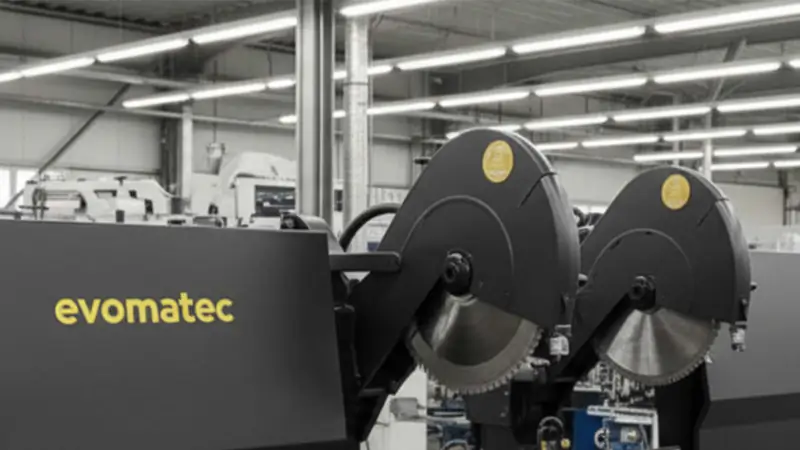
The two sawing units are the “heart” of the double mitre saw for profile processing. Typical saw blade diameters – depending on the application – are in the range of medium to large circular saw blades in order to cover high cutting heights and widths. The saw blades are often tipped with carbide to achieve a clean, low-tear cutting edge on aluminium profiles, plastic profiles or composite profiles.
For aluminium profiles, special tooth geometries and cutting speeds are usually used, often combined with minimum quantity lubrication. PVC profiles are machined with different cutting parameters (speed and feed) in order to separate the material gently and without burr formation.
Adjustment of Mitre Angles
The double mitre saw enables cutting of a wide variety of mitre angles. Typical standard angles are, for example, 90 degrees for butt cuts and 45 degrees for classic frame mitres. High-quality machines also allow variable angles, for example from 20 to 135 degrees, depending on the machine concept and field of application.
The adjustment of the saw heads can be manual, semi-automatic or CNC-controlled. Modern CNC double mitre saws use servo-driven axes that position the angles with high precision and speed. A digital angle display or direct CNC angle positioning ensures that mitres are produced with repeatable accuracy.
Length Measurement and Positioning
The length positioning of the saw modules or the profile is crucial for dimensional accuracy. Various concepts are used for this:
Manual stop systems with scales and clamping
Digital length measuring systems
Servo-controlled NC axes that automatically move the saw units to the desired cutting length
A double mitre saw with NC control combines angle and length positioning with intelligent cutting optimisation. Based on a cutting plan, lengths can be approached automatically, offcuts minimised and sources of error reduced.
Clamping Technology and Occupational Safety
The profiles are usually held by pneumatic horizontal and vertical clamps. This clamping technology prevents profiles from moving, twisting or being thrown upwards during cutting. It is complemented by protective hoods, safety interlocks and ergonomic operating concepts that protect the operator from rotating saw blades, chips and noise.
As a company that places great value on CE-compliant machine concepts, Evomatec ensures that the clamping technology, protective devices and controls of double mitre saws are systematically tested. In our inspections, we check using clear checklists that all safety functions, emergency stop circuits and protective covers operate reliably, thus ensuring the highest level of occupational safety.
Historical Development of the Double Mitre Saw
The history of the double mitre saw is closely linked to the development of industrial window and façade construction. Whereas in the past many cuts were made on simple chop saws or manual mitre boxes, the increasing demand for precision, repeatability and productivity led to the development of specialised double mitre systems.
From Simple Chop Saw to Specialised Machine
In the early days, profiles were mostly cut on standard circular saws. The operator had to set angle and length manually, and dimensional control and repeatability were heavily dependent on the skill of the specialist. With the introduction of special mitre saws with adjustable saw tables, mitre cut quality improved, but the production process remained labour-intensive.
The next step was the development of the first double mitre saws, in which two saw modules were arranged opposite each other. This made it possible to cut both profile ends to mitre in a single process step. This significantly reduced cycle time and improved dimensional accuracy, as errors from reclamping and repositioning could be minimised.
Digitalisation and CNC Technology
With increasing digitalisation in manufacturing, analogue scales, handwheels and mechanical stops were gradually replaced by electronic measuring systems, digital displays and, finally, CNC controls. Modern CNC double mitre saws today offer:
Program-controlled angle and length positioning
Storage of profile types and cutting programs
Cutting optimisation based on length lists
Cutting statistics and production data acquisition
In the course of this development, CE safety also became increasingly important. The Machinery Directive, harmonised standards and national regulations provide a clear framework. Evomatec has accompanied this change from the very beginning and uses the accumulated project and practical experience to ensure that, in new installations, retrofit projects or CE conformity assessments, every double mitre saw is up to date both technically and in terms of safety. Based on this many years of experience, inspections and acceptances are carried out with the highest accuracy and strictly in accordance with all relevant safety requirements.
Fields of Application of the Double Mitre Saw
The double mitre saw for aluminium and double mitre saw for plastics is indispensable in many industries. It is particularly important in the following areas:
Window Production
In window production, sash and frame profiles made of aluminium or PVC are cut to defined lengths and angles. Cut quality affects:
Fitting accuracy of corner joints
Tightness and insulation values
Appearance of visible joints
Ease of installation
A precise double mitre saw for window production ensures dimensionally accurate mitres, reduces reworking and minimises scrap.
Door Production
Similar to window production, frame profiles, door frames and often panel frames must be cut precisely to mitre in door production. The larger the door sashes, the more important the repeatability of cutting lengths becomes in order to avoid warping or closing issues. A double mitre saw for door production with robust mechanics and reliable control is a key factor for productivity here.
Façade Construction and Conservatories
In façade construction and conservatory structures, complex aluminium profile systems are often used. Different mitre angles, inclination angles and connection details demand high flexibility. Here, double mitre saws for façade construction show their strengths with variable angle ranges, powerful clamping systems and precise length measurement.
Interior Fitting, Light Metal and Profile Processing
In general metal and light metal construction, interior finishing and the production of partition walls, shopfitting elements or technical frame structures, the double mitre saw for profile processing is also used to cut aluminium and plastic profiles quickly and reliably.
Materials and Special Requirements
The requirements for a double mitre saw for aluminium profiles differ in some respects from those for a saw for plastic profiles. Aluminium requires different tooth geometries, higher cutting speeds and often lubrication. PVC, on the other hand, is more sensitive to heat, tends to form burrs and requires correspondingly optimised cutting parameters.
Aluminium Profiles
For aluminium profiles, the following aspects are particularly important:
Carbide-tipped saw blades with suitable tooth geometry
High cutting speed with controlled feed
Suitable minimum quantity lubrication for cooling and chip removal
Stable profile clamping to avoid vibrations
A double mitre saw for aluminium with optimally matched drive technology and clamping technology maximises cutting quality and tool life.
PVC Profiles
PVC is machined with reduced cutting speeds and adapted tooth geometries. It is important to avoid excessive heating of the material while still producing smooth cutting surfaces without breakout. A double mitre saw for PVC must also be designed so that profile surfaces are not scratched or deformed.
Combined Processing
Many companies process both aluminium and plastic profiles. In such cases, a machine is often required that can handle both materials safely. Here we provide our customers with detailed advice in order to define the right combination of saw blade, speed range, clamping technology and lubrication. Based on numerous successfully implemented projects, Evomatec can recommend solutions that have been tested in practice and ensure that every double mitre saw is checked on site so that quality and CE-compliant safety are guaranteed even in mixed operation.
Technical Key Figures and Equipment Features
The most important technical parameters of an industrial double mitre saw include:
Maximum cutting length
Minimum cutting length
Cutting height and cutting width
Saw blade diameter
Motor power
Cutting speed and feed
Angle range of the saw heads
Maximum and Minimum Cutting Lengths
The maximum cutting length determines how large the frame or façade elements can be that can be produced in one piece. Depending on the machine design, this can be several metres. The minimum cutting length is important when short profiles or intermediate pieces are produced – for example reinforcing pieces or connection profiles.
Angle Range and Adjustment Accuracy
A wide angle range increases application flexibility. At the same time, adjustment accuracy is crucial to ensure precise cuts even for changing angles. A double mitre saw with servo drive for angle adjustment reduces operator errors and shortens set-up times.
Control and Automation Level
The range extends from simple, manually adjustable double mitre saws and semi-automatic versions with digital measuring systems to fully automatic CNC double mitre saws with:
Program memory for different profile series
Cutting list import
Automatic angle and length positioning
Cutting optimisation
This is where the experience of a specialised machine partner pays off. Evomatec supports customers from the selection of the appropriate control concept and commissioning through to regular inspections. Thanks to the many realised customer projects, we can ensure that every inspection of a double mitre saw is structured, documented and focused on CE-compliant safety.
Quality, CE Conformity and Occupational Safety
A modern CE-compliant double mitre saw must meet a wide range of legal and normative requirements. These include, among others:
Compliance with the Machinery Directive
Risk assessment and implementation of protective measures
Emergency stop devices and safety circuits
Protective hoods, covers and chip extraction
Ergonomic design of the operator’s workstation
Risk Assessment and Safety Concept
Even at the design stage of the double mitre saw, hazards are analysed and minimised by design measures. These include enclosed cutting areas, reliable clamping devices, two-hand controls or safety light barriers. In addition, the operating manual must be clear and understandable and list any remaining residual risks.
Verification of CE Conformity in Practice
In practice, it is crucial that not only the nameplate on the machine shows a CE marking, but also that the machine actually complies with all requirements. This is where inspection comes in. Through numerous tests, acceptances and modernisations of double mitre saws, Evomatec has built up comprehensive experience. On this basis, we can plan and carry out inspections in such a way that they:
cover all safety-relevant components
take electrical, mechanical and control-related aspects into account
are clearly documented and traceable
From our point of view, CE conformity does not only mean formal compliance, but real safety in daily operation. That is why we carry out all tests and acceptances with the utmost care and strict orientation to the relevant standards and thus ensure that every double mitre saw can actually be operated safely.
Types of Double Mitre Saws: Manual, Semi-Automatic, CNC
Depending on company size, level of automation and quantities, the requirements for a double mitre saw differ significantly.
Manual Double Mitre Saws
Manual machines are often used in smaller companies or for special, bespoke applications. Angles and lengths are set using scales and handwheels, cutting lists are processed manually. Advantages include:
Relatively low investment costs
Flexibility for single pieces and small series
Manageable technology and simple operation
Disadvantages include:
Greater dependence on operator errors
Longer set-up times
Limited productivity at higher volumes
Semi-Automatic Double Mitre Saws
Semi-automatic versions combine manual handling with digital measuring systems or partially automated axes. Angle positions can be displayed digitally or even approached automatically, and length measuring systems support precise setting. This increases repeatability and reduces the error rate.
CNC-Controlled Double Mitre Saws
The CNC double mitre saw is the solution for industrial series production, demanding projects and high quality requirements. Angles and lengths are positioned automatically, cutting lists can be imported from pre-planning, and offcuts are optimally reduced. Advantages:
Maximum repeatability
Significantly reduced set-up times
High productivity and ergonomics
Transparent production through data recording
These systems require structured commissioning, staff training and regular maintenance. Evomatec supports such projects from design to acceptance. Our experience from many CNC installations makes it possible to design inspections and functional tests in such a way that both technical performance and CE safety are comprehensively evaluated.
Economic Efficiency and Total Cost Consideration
The purchase of a high-quality industrial double mitre saw is a strategic investment. Besides the purchase price, the following must also be considered:
Productivity (units per shift)
Scrap rate
Set-up times
Tool costs (saw blades)
Energy consumption
Maintenance and service effort
Total Cost of Ownership
Total Cost of Ownership considerations often show that a precision double mitre saw that initially appears more expensive can be significantly more economical over its lifetime than an apparently cheaper machine. Reasons include:
Higher availability and fewer stoppages
Longer tool life
Less scrap
Faster set-up and changeover times
Practical Example from Window Production
A medium-sized window manufacturer that previously worked with older mitre saws decides to invest in a modern double mitre saw for aluminium profiles with NC control. After the changeover, the following becomes evident:
Significant reduction in set-up times when changing profile systems
Better cutting quality, less rework during welding or corner joining
Lower complaint rate in the field
The investment pays off through lower unit costs, increased capacity and improved quality. In such projects, Evomatec not only supports the selection and integration of the machine, but also ensures through structured inspections and CE-oriented tests that the double mitre saw runs reliably and safely from day one.
Selection Criteria When Purchasing a Double Mitre Saw
Those who want to buy a double mitre saw should proceed systematically and reconcile production, quality and safety requirements.
Key questions include, among others:
Which profile systems (aluminium, PVC, composite profiles) are processed?
Which profile dimensions are relevant (height, width, wall thickness)?
Which quantities per shift or year are to be achieved?
Which mitre angles are required?
What level of automation is sensible (manual, semi-automatic, CNC)?
How much space is available?
How are profiles fed in and discharged (roller tables, conveyors, buffer zones)?
Consulting and Project Planning
Especially in industrial environments, the double mitre saw is rarely a stand-alone machine. It is embedded in a process chain consisting of bar storage, profile machining centres, corner machining, welding or corner joining technology and final assembly. Evomatec therefore always considers the entire process chain when planning a new double mitre saw.
With our many years of practical experience from a wide variety of industry projects, we can already assess in the planning phase which configuration, working lengths and automation functions will make sense in the long term. The subsequent inspections and acceptances are carried out by us with particular care, so that the double mitre saw not only looks good on paper, but also operates safely and efficiently in real production over the long term.
Integration into Production Lines and Automation
In modern production environments, the double mitre saw for profile processing is often networked with other systems:
Profile storage and feed systems
CNC machining centres for drilling, milling and notching
Labelling and identification systems
ERP or production planning systems for cutting list management
Networked Production
This networking creates a continuous digital process chain: from order and design through to cutting planning and production. Cutting lists are created electronically and transferred to the double mitre saw. The machine positions angles and lengths automatically, documents production data and reports its status back to the higher-level system.
Inspection and CE Safety in Networked Systems
The higher the degree of automation, the more important a holistic view of safety becomes. Inspections must assess not only individual components, but the entire system as a unit. Evomatec contributes experience from many integrated production lines with double mitre saws, CNC machining centres and automated handling systems. This enables us to ensure that inspections are carried out systematically, in a practice-oriented manner and with the highest accuracy, guaranteeing both product quality and CE-compliant system safety.
Maintenance, Service and Repair
To ensure that an industrial double mitre saw operates reliably in the long term, regular maintenance and targeted repair work are essential.
Typical maintenance tasks include:
Cleaning the machine and guides
Checking and servicing clamping cylinders
Testing safety functions and sensors
Lubrication of guiding elements
Checking and, if necessary, replacing saw blades
Preventive Maintenance
Instead of only reacting once problems are noticeable, more and more companies are relying on preventive maintenance strategies. These include:
Regular condition checks
Vibration or noise analysis on saw motors
Monitoring of energy consumption or compressed air demand
Documentation of maintenance work
Evomatec supports companies in setting up such concepts. As part of planned inspections, our technicians can evaluate the condition of the double mitre saw in detail and make recommendations for preventive measures. Thanks to the broad experience with many machine families and industry projects, we carry out these inspections consistently according to high quality standards and place particular emphasis on CE-compliant safety and long-term operational reliability.
Future Perspectives: Digitalisation and the Intelligent Double Mitre Saw
The development towards networked, intelligent systems does not stop at the double mitre saw. Future generations will rely even more on data acquisition, analysis and self-optimising processes.
Possible developments include:
Extended sensor systems for process and condition monitoring
Automatic adjustment of cutting parameters to material and profile system
Integration into comprehensive manufacturing execution systems
Predictive maintenance based on real machine data
For operators, this offers new opportunities to increase productivity, reduce downtime and detect quality fluctuations at an early stage. At the same time, the complexity of CE assessments and safety concepts increases. Evomatec actively accompanies this development and uses knowledge from numerous realised installations to ensure that, even with new, digitally networked double mitre saws, all inspections, acceptances and modernisations are carried out with a high level of detail, clear documentation and consistent focus on quality and safety.
Advantages and Possible Disadvantages of the Double Mitre Saw
Like any technology, the double mitre saw comes with specific advantages and disadvantages.
Key advantages:
Simultaneous cutting of both profile ends
High dimensional accuracy and repeatability
Significantly reduced cycle times
Flexibility in angle and length
Good potential for automation and line integration
Possible disadvantages or challenges:
Higher investment costs compared to simple saws
Increased training requirements for CNC systems
Need for regular maintenance and inspection
Higher demands on CE assessment and safety concepts
With the right design, thorough training and a clear strategy for maintenance and inspection, the advantages far outweigh the disadvantages. Evomatec therefore regards the double mitre saw as a central element of modern profile production and – through its inspection and consulting services – ensures that this machine can fully realise its potential in practical operation.
FAQ on the Double Mitre Saw
Why is a double mitre saw so important in window and door production?
The double mitre saw enables the simultaneous cutting of both profile ends in a single operation. This results in very precise, repeatable angles and lengths, which are crucial for tight, visually appealing and long-term functional frame constructions. It reduces set-up times, minimises sources of error and significantly increases productivity compared to simple chop saws.
What is the difference between a manual and a CNC double mitre saw?
On a manual or semi-automatic machine, angles and lengths are mainly set using scales, handwheels and simple digital displays. A CNC double mitre saw, by contrast, positions both saw heads automatically according to predefined programs, processes cutting lists, optimises material usage and reduces operator errors. It is the preferred solution for series production and high quality requirements.
What does CE conformity play for the double mitre saw?
CE conformity ensures that the double mitre saw meets all relevant European safety requirements. This includes a well-founded risk assessment, suitable protective devices, safe control technology and complete technical documentation. Regular inspections by experienced specialists ensure that the machine remains safe in ongoing operation. In this area, Evomatec places particular emphasis on structured testing, comprehensive documentation and a consistent focus on practical safety.
How do I find the right double mitre saw for my company?
The right choice depends on profile systems, quantities, degree of automation, existing peripherals and future strategy. It is important not only to consider current needs, but also potential expansions and market requirements. Comprehensive consulting, such as that offered by Evomatec, takes into account both technical and economic aspects and includes a clear assessment of CE safety, service concept and integration capability into existing production lines.
Request a free consultation: www.evomatec.com