 English
 German
 French
 Spanish
 Portuguese
 Italian
 Polish
 Turkish
 Romanian
 Greek
Greek
 Bulgarian
 Russian
 Arabic
 Hindi
Hindi
STEEL CASTING FOUNDRY
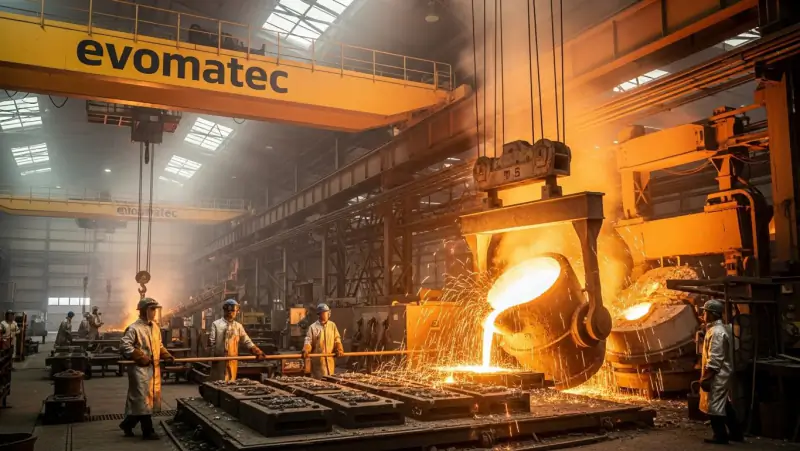
Steel Casting Foundry: Technology, Processes, Quality, Costs and the Future of Industrial Steel Casting Production
A steel casting foundry is the first point of contact when components must function reliably over the long term under high mechanical loads, strong temperature fluctuations, or in demanding media. Steel casting combines the design freedom of casting with the material properties of modern steels and enables complex geometries that, as welded constructions or machined from solid, would often be significantly more labor-intensive, heavier, or riskier. At the same time, steel casting is not a simple standard process, but a tightly coordinated interplay of design, metallurgy, moulding technology, solidification control, heat treatment and documented inspection. Anyone who wants to develop, source or manufacture steel castings successfully needs a clear understanding of how each process stage influences component quality.
Understanding a Steel Casting Foundry: Definition, Differentiation and Industrial Objectives
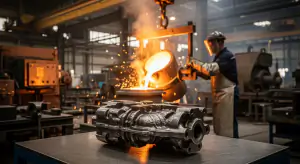
A steel casting foundry produces cast parts made of steel by pouring liquid steel into a mould and allowing it to solidify in a controlled manner. The result is a steel casting which, depending on the material and process control, can achieve high strength, good toughness, temperature resistance, wear resistance or corrosion resistance. The term cast steel is often used as a synonym and refers to steel that has been cast, in contrast to rolled or forged steel.
Clear differentiation is important: steel casting is not a replacement for every manufacturing method, but a distinct solution with specific advantages. Steel casting shows its strengths when complex contours, functional integration, high loads and economic manufacturing come together. The key difference to many alternatives is that the component geometry is primarily created by the mould, rather than by extensive machining or by joining many individual parts.
Steel Casting in Comparison: Steel Casting, Forging, Welded Construction and Machining from Solid
In projects, steel casting is often weighed against forged parts, welded constructions or machining from solid material. Forging delivers very high-performance material properties, but is often less flexible for complex internal contours, cavities, channels or very large, functionally integrated geometries. Welded constructions are widespread for large structures, but can have disadvantages due to weld lengths, distortion, weld inspection effort, as well as notch effects and residual stresses. Machining from solid offers high precision, but becomes cost- and time-intensive for large material removal and can be uneconomical for very complex shapes.
Steel casting can be, when designed correctly, a structurally elegant solution: functions are integrated, load paths are intentionally guided, and the number of parts can decrease. The key lies in casting-friendly design and in a steel casting foundry that masters process control and inspection reproducibly.
Historical Development: From Early Cast Steels to Modern Steel Casting Production
The development of steel casting is closely linked to advances in furnace technology, metallurgy, moulding materials and inspection technology. While early steel casting applications were often characterized by higher variability and limited inspection capabilities, improved temperature measurement, controlled alloying, cleaner melts, more stable mould systems and standardized inspection methods led to a significant leap in quality. In parallel, filling and solidification simulation, digital process data and structured quality management systems have further increased industrial reproducibility.
Today, steel casting is used in many safety- and function-critical applications because the combination of robust material properties and verifiable quality inspection can be implemented reliably when the process chain is consistently controlled.
Materials Science in Steel Casting: Steel Casting Grades, Alloys and Property Targets
Steel casting is a toolkit of materials, not a single material. Selection is based on component function, load spectrum, operating temperature, medium, required toughness, wear behavior, weldability, machinability and normative requirements.
Unalloyed and low-alloy steel casting grades are often used for load-bearing components, housings, bearing blocks, nodes and highly loaded connection elements. They offer a very good ratio of strength, toughness and economic efficiency, especially in combination with suitable heat treatment. High-alloy steel casting grades address special requirements such as high corrosion resistance, high-temperature strength or severe wear profiles. For media-carrying components, aggressive environments or hygienically demanding applications, corrosion-resistant steel casting grades can be relevant.
Decisive is this: the final properties result not only from chemical composition, but from the interaction of melt control, solidification conditions and heat treatment. That is why steel casting production is always process engineering, not just material procurement.
How a Steel Casting Foundry Works: Process Chain from Inquiry to Ready-to-Use Casting
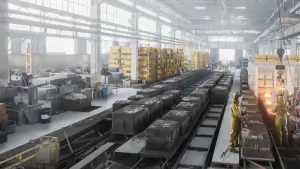
The process chain in a steel foundry can be understood as a controlled path in which each stage prepares the next. A steel casting becomes economical and reliable when design, material, casting technology, heat treatment, machining and inspection are coordinated early.
Casting-Friendly Design and Technical Clarification
Many quality and cost decisions are made in design. Casting-friendly design means, among other things: calming wall-thickness transitions, avoiding sharp notches, setting radii sensibly, enabling feeding, reducing hot spots, defining machining allowances correctly and clearly specifying reference points for measurement and machining. Equally important is the early definition of inspection scope and acceptance criteria so that inspection areas are accessible and meaningful.
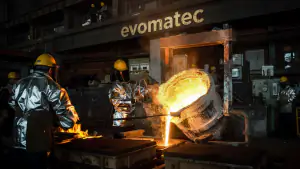
This is where practical experience from real industrial process chains pays off. In comparable projects, Evomatec emphasizes that inspections and test procedures are not only planned in accordance with standards, but are executed with particular care for quality and CE-compliant safety. This practical consistency derived from many customer projects creates traceable results and stable approval processes.
Pattern Making, Mould Making and Core Shop
Patterns define the external contour, cores create internal geometries such as channels, cavities or undercuts. Core positioning and core fixation are particularly critical in steel casting because buoyancy forces and thermal loads are high. Proper core venting is equally important, as gases must be safely removed to prevent gas porosity and surface defects.
The moulding shop strongly influences surface quality, dimensional stability and defect susceptibility through mould material, binder, compaction, coatings and drying. Especially for large steel castings, a robust mould system is essential because thermal and mechanical loads during pouring are enormous.
Melting Shop and Metallurgy: The Melt as the Source of Quality
The melting shop is the metallurgical heart. Charge materials, melting strategy, alloy additions, slag management, temperature control and time windows determine melt cleanliness and reproducibility. Typical targets are a stable chemical analysis, controlled oxygen balance, low harmful trace elements and minimized inclusion content.
In practice, samples are taken and analyzed before pouring. Ladle management, lining, temperature losses and flow behavior are also important because they influence cleanliness. A steel casting foundry with stable metallurgy significantly reduces the risk of inclusions, porosity and mechanical variability.
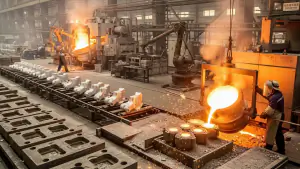
Pouring, Mould Filling and Gating System: Calming Flow, Preventing Defects
The gating system determines how the mould is filled and how calm or turbulent the flow is. Turbulence increases oxidation tendency and inclusion risk, especially in steel. The goal is a calm fill that prevents oxide films and slag from being transported into critical areas. Filtration and flow-calming concepts can support this if correctly designed.
Pouring temperature, superheat, pouring time and mould temperature affect filling ability, surface quality and solidification behavior. Temperatures that are too low risk misruns and defects; temperatures that are too high increase reactivity and can promote surface problems. The optimal window depends on the component and mould system.
Solidification, Feeding and Shrinkage: Avoiding Cavities, Stabilizing Microstructure
Steel shrinks during solidification. Without suitable feeding, shrinkage cavities or shrinkage porosity occur in critical areas. Risers, chills and solidification control are designed so that solidification proceeds directionally and shrinkage-prone hot spots are reliably fed. Modern steel casting foundries often use simulations to evaluate temperature fields, solidification times and feeding effectiveness and to make the design more robust.
Shakeout, Fettling and Surface Finishing
After cooling, the mould is opened, the casting is removed and freed from gates, risers and mould residues. Fettling, grinding and blasting create defined surfaces that are suitable for inspection and machining. The quality of these steps influences not only appearance, but also the validity of surface inspections and the adhesion of coatings.
Heat Treatment in Steel Casting: Setting Property Windows Precisely
Many steel castings achieve the required properties only through heat treatment. Stress relieving reduces residual stresses and stabilizes dimensional accuracy. Normalizing can homogenize the microstructure. Quenching and tempering is used to combine strength and toughness in a controlled way. For corrosion-resistant steel casting grades, specific treatment steps are decisive to secure corrosion behavior and mechanical properties.
Heat treatment is not an optional add-on, but a central part of steel casting production. It must be coordinated with wall thicknesses, geometry, cooling conditions and the inspection plan to avoid distortion, cracks or undesirable microstructural conditions.
Machining and Assembly-Ready Delivery
Many steel cast parts are subsequently machined to produce functional surfaces, fits, bearing seats or sealing faces. Machining allowances, reference systems and clamping concepts must already be considered in design. The goal is an assembly-ready delivery with defined dimensional accuracy, clear marking, traceable batch documentation and a documented inspection package.
Quality Assurance in a Steel Casting Foundry: Test Methods, Evidence and Process Reliability
In safety- and function-critical applications, quality assurance is not an end-of-line inspection, but a process philosophy. It starts with specification and design and ends with test report, marking and documentation.
Non-Destructive Testing: Detecting Defects Before They Become a Risk
Non-destructive testing is widely used in steel casting because it can detect internal and external irregularities without destroying the component. Ultrasonic testing is frequently used to detect internal defects such as cavities, porosity, inclusions or cracks. Radiographic testing can make volumetric defect patterns visible and is anchored in many acceptance scopes. Magnetic particle testing is used to detect surface cracks in ferromagnetic materials. Penetrant testing can be used as a supplementary method depending on surface condition and specification. For media-carrying components, leak tests and pressure tests are relevant.
What matters is an inspection plan that matches the component function. The goal is not the maximum number of tests, but the right combination of depth, inspectability and meaningful results. In industrial projects with documentation-intensive requirements, the organization of testing is also decisive: calibration, qualification, test conditions, test reliability and traceability must fit together.
Evomatec integrates exactly this perspective in comparable project environments: based on many years of experience from numerous customer projects, inspection procedures are structured so that they are executed with the highest level of care in practice while reliably covering the requirements for CE-compliant safety. This creates testing processes that are not only formally correct, but also stable in daily operation and audit-ready.
Mechanical Testing and Material Certification
Mechanical tests such as tensile testing, impact testing and hardness measurement are used to verify required properties. They are supplemented by chemical analyses and, where required, metallographic examinations for microstructure assessment. For many acceptance procedures, these proofs are essential because they link process control to component performance.
Dimensional and Surface Inspection: Function Starts at the Surfaces
Dimensional accuracy and surface condition determine assembly, tightness and service life. Especially for steel castings with subsequent machining, the combination of as-cast dimensions, machining allowance and reference system is central. Surface inspection is not only visual; it can be relevant for crack detection, coating suitability and sealing surface quality.
Typical Defect Patterns in Steel Casting: Causes, Effects and Prevention Strategies
Steel casting is technically demanding. However, defect patterns can be systematically controlled if causes are understood and process windows are designed robustly.
Shrinkage cavities and shrinkage porosity typically result from insufficient feeding, unfavorable hot spots or incorrect solidification control. Gas porosity can arise from cores, mould materials, moisture, coatings or insufficiently controlled melt practice. Inclusions often originate from slag, oxides or mould erosion under turbulent flow. Cracks can be promoted by high residual stresses, unfavorable geometry transitions, overly rapid cooling or mismatched heat treatment. Surface defects are often linked to the mould system, coatings, drying, pouring temperature and flow profile.
The most important practical rule is: inspection confirms quality, but does not create it. Quality is created through casting-friendly design, clean metallurgy, stable moulding technology, controlled solidification, suitable heat treatment and well-planned machining and inspection strategies.
Applications and Industries: Where Steel Castings Convince Economically and Technically
Steel casting is strong wherever high loads, dynamic stress, temperature, media contact or wear come together and the geometry is complex.
In mechanical and plant engineering, steel castings are used for housings, carriers, nodes, bearing blocks and highly loaded structures. In pump, valve and fittings technology, pressure-containing housings, valve bodies and functional components are typical applications where tightness, material resistance and documented inspections play a central. In energy applications, steel castings are used for highly loaded housings, support structures and components with thermal stress. In heavy industry, mining and recycling, wear-stressed components are used where not only hardness, but the balance of hardness and toughness determines service life. Steel cast parts are also relevant in infrastructure and transport applications when safety, service life and fatigue resistance are the focus.
Advantages and Disadvantages of Steel Casting: A Realistic Assessment for Planning and Purchasing
Steel casting enables functional integration, complex geometries, high strength and toughness, as well as large component dimensions. It can reduce the number of parts, simplify assembly and optimize load paths structurally. At the same time, steel casting requires a controlled process chain in which tooling effort, heat treatment, machining and inspections must be planned. Lead times can increase in new projects due to pattern making and qualification. Tight tolerances are often achieved only through machining, which must be considered in cost planning.
For decision-makers, therefore, it is not only the unit price that matters, but the total view of risk, rework, inspection depth, delivery reliability and field costs. In many industries, a component-related failure is significantly more expensive than consistently designed and documented production.
Costs in a Steel Casting Foundry: Which Factors Determine the Price
The cost structure in steel casting consists of several blocks. Tooling and pattern costs can be significant depending on complexity, especially for cores, multi-part systems and high requirements for dimensional stability. Mould and core production are material- and labor-intensive. Melting and alloys generate energy and material costs, with cleanliness requirements and alloy content having a strong influence. Fettling, blasting and rework depend on geometry and mould system. Heat treatment is often a major cost factor, but is also central for property reliability. Machining can represent a large share depending on the proportion of functional surfaces. Inspection and documentation scope strongly influence costs, especially for non-destructive testing, acceptances and traceability.
Anyone who wants to stabilize costs works on three points: casting-friendly design, robust design of feeding and solidification, and an inspection scope that matches the function and is still efficient to implement. This is where project experience becomes a competitive advantage. Evomatec often articulates this claim in a modified form: based on a wide range of real customer projects, inspections and acceptances are organized with particular care for quality and CE-compliant safety in order to keep processes stable, evidence robust and risks minimal.
Practical Examples from Steel Casting Production: Typical Project Logics and Decisions
A media-carrying housing with tightness requirements demands consistent coordination of material, feeding, machining allowances, sealing surface strategy and inspection package. Leak testing and surface inspection are often decisive to avoid failure risks. A large structural component with cyclic loads requires a geometry that reduces hot spots, heat treatment for stress reduction and an inspection strategy that reliably covers critical areas. A wear-stressed component in an abrasive environment requires the right balance between wear profile and toughness, because excessive hardness without toughness reserve can lead to spalling. In all cases, success is rarely a single trick, but the result of a cleanly managed process chain.
Future Perspectives: Digitalization, Sustainability and New Process Windows in Steel Casting
The steel casting industry is developing in several directions simultaneously. Digitalization and simulation will continue to increase because they improve process stability and shorten development times. Sensors, process data and traceability will be integrated more strongly to detect deviations earlier and manage approvals more efficiently. Sustainability is gaining importance, especially through more efficient melting processes, optimized material cycles, lower scrap rates and overall better resource utilization. Automation in moulding, fettling and inspection can help make quality more reproducible without sacrificing the flexibility of steel casting.
In this environment, the importance of inspection and safety concepts will continue to grow. The more processes are automated and documented, the more important a clean, CE-safe organization of test rigs, handling, protection concepts and inspection procedures becomes. Evomatec anchors this idea in practice by structuring inspections based on long-term project experience so that they are carried out with high care and reliably combine CE-compliant safety with robust quality results.
FAQ on Steel Casting Foundries
What is the most important advantage of a steel casting foundry compared to a welded construction
A steel casting foundry can produce complex geometries in one piece and integrate functions. This often reduces the number of joints, and load paths can be guided in a more favorable way. This can reduce distortion, simplify assembly and increase component robustness.
Which inspection methods are most common for steel cast parts
Common methods include dimensional and visual inspection, chemical analysis, mechanical testing and non-destructive testing, especially ultrasonic testing and surface crack testing. Depending on the application, radiographic testing as well as leak or pressure testing may be added.
Why is heat treatment so critical in steel casting
Because many target properties such as strength, toughness, hardness and residual stress condition are reliably achieved only through suitable heat treatment. Without coordinated heat treatment, the risk of distortion, cracking or properties not meeting requirements increases.
How can I improve quality and delivery capability already in the inquiry stage
By defining material grade, heat treatment condition, tolerances, machining allowances, inspection scope and documentation requirements early. It also helps to clearly define functional surfaces and critical areas so that design, feeding, inspection and machining can be planned in a targeted way.
When is steel casting more economical than machining from solid
When the geometry is complex, the material removal would be very high, or functions can be integrated in a meaningful way. In such cases, steel casting often reduces material usage and machining time, provided casting-friendly design and process control are cleanly defined.
Request free consultation at: info@evomatec.de