 English
 German
 French
 Spanish
 Portuguese
 Italian
 Polish
 Turkish
 Romanian
 Greek
Greek
 Bulgarian
 Russian
 Arabic
 Hindi
Hindi
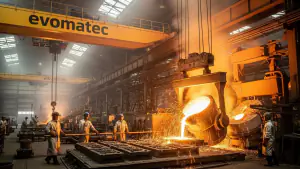
ALUMINIUM CASTING FOUNDRY
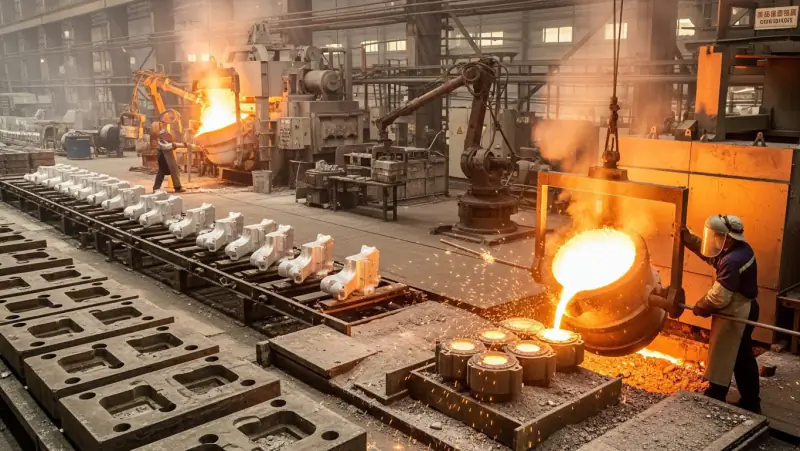
Aluminium Casting Foundry: Technology, Processes, Quality and the Future of a Key Industrial Technology
Aluminium casting foundry explained clearly: processes, alloys, quality assurance, costs, applications and future trends for precision cast components in industry
Introduction: Why an aluminium casting foundry is more important than ever today
An aluminium casting foundry is a central partner for many industries when it comes to lightweight, stable and economically manufacturable components. Aluminium casting combines design freedom with high suitability for series production and enables geometries that are often only achievable through machining from solid material or forming at significantly higher cost. At the same time, requirements are rising: lower component weights, higher functional integration, documented quality, resilient supply chains and clearly verifiable safety standards. Anyone commissioning aluminium castings or producing them in-house operates in an environment where metallurgy, process control, material selection, tooling technology and inspection technology are closely interlinked. The objective is always the same: repeatable castings that reliably meet mechanical properties, dimensional accuracy, surface requirements and standard specifications. This is precisely where the difference becomes apparent between a purely executing operation and an industrially positioned process partner that works with stable process windows in series projects and documents each batch with full traceability. In industrial day-to-day business, it is not only the casting results that matter, but also upstream and downstream steps: component design, casting-ready design, simulation, tooling concept, heat treatment, machining, leak testing and final inspection. The greatest levers for quality and, at the same time, the greatest risks arise at these interfaces. Therefore, the rule is: the better the aluminium casting foundry controls the overall process, the more reliable delivery capability and component safety will be
Fundamentals: What is aluminium casting and what does it achieve in comparison?
Aluminium casting is a process in which molten aluminium or an aluminium alloy is introduced into a mould and solidifies there. The solidified workpiece is then demoulded, cleaned, heat-treated if required and mechanically machined. The major advantage lies in design freedom: ribs, cavities, functional surfaces, flanges, mounting points and complex wall-thickness transitions can be integrated into a single near-net-shape casting
Aluminium casting compared with steel and cast iron
Compared with steel casting or iron casting, aluminium casting offers a significantly lower density. As a result, components with similar geometry are considerably lighter. For applications with dynamic loads, energy-efficiency requirements or easier handling, this is a clear advantage. At the same time, aluminium is highly recyclable and can be managed in closed material loops, provided alloy cleanliness and melt management are properly controlled. Cast iron often impresses with very good damping and high compressive strength, while steel casting is used for extreme mechanical requirements. Aluminium casting sits in between: an excellent strength-to-weight ratio, good corrosion resistance in many environments and a wide range of alloy options for specific requirements such as thermal conductivity, leak-tightness or fatigue strength
Aluminium casting compared with machining from solid material
Milling or turning from solid material can be sensible for small quantities, but it becomes expensive, material-intensive and time-consuming for complex shapes. Aluminium casting provides a near-net-shape blank that lies close to the final contour. Machining is therefore focused on functional surfaces, fits and sealing faces. This reduces material consumption, machining time and tool wear. In practice, the combination of casting and precise downstream machining is decisive. Process chains can be designed so that casting quality and machining strategy fit together optimally. In such integrated concepts, subtle references to Evomatec can be appropriate, for example when it comes to robust, industrial-grade manufacturing steps in profile and component machining that align with clear quality and safety requirements
Historical development: From craft casting to process industry
The basic idea of casting has been known for millennia, but aluminium casting only became a mass process with the industrial availability of aluminium and suitable melting technologies. Early applications focused on simple shapes and low requirements. With the growth of mechanical engineering, vehicle manufacturing, energy technology and electrical engineering, expectations increased: thinner wall sections, higher strengths, better surfaces, tighter tolerances and more stable series processes. A key step was the standardisation of alloys and heat treatments as well as the growing control of gas and oxide inclusions. At the same time, tooling technology advanced: more precise moulds, optimised gating systems, improved venting and controlled temperature management. Today, simulation, process data acquisition, statistical process control and non-destructive testing are standard in many projects. Modern aluminium casting foundries no longer work only with experience, but with measurable process windows, traceability and defined approval processes. Safety is also gaining importance. In industrial practice, inspections, acceptances and safety tests are not treated as a formality, but as an integral part of the quality promise. From a wide range of real customer projects, it can be derived how important consistently documented inspection processes and CE-compliant safety standards are to ensure long-term stable series quality
Materials science: Alloys, properties and selection criteria
The choice of aluminium alloy is one of the most important decisions in a project. It influences castability, mechanical properties, corrosion behaviour, thermal conductivity, machinability and cost. An aluminium casting foundry therefore considers not only the component, but also the entire process chain: what loads occur, what temperature cycles apply, what leak-tightness requirements exist, what surfaces are needed, and what machining steps follow?
Castability and solidification behaviour
Castability describes how well a melt fills thin areas, how evenly it solidifies and how susceptible it is to shrinkage cavities, porosity or hot tearing. Alloys with suitable silicon contents are often very casting-friendly, which is especially important for complex geometries. At the same time, the alloy influences shrinkage, the feeding concept and the required process stability
Strength, ductility and fatigue
Many applications require not only high static strength, but also good fatigue properties. Porosity, inclusions and microstructure play a major here. Clean melt handling, controlled solidification and appropriate heat treatment are often more decisive than a theoretically particularly “strong” alloy system
Heat treatment and microstructure
Heat treatments can significantly increase strength, influence ductility and improve the long-term stability of properties. However, they only work reliably if casting quality and alloy control are consistent. A professionally positioned aluminium casting foundry combines alloy selection, casting process and heat treatment into a coordinated overall concept
Casting processes at a glance: Which technology suits which component?
There is no single aluminium casting process. Different components require different process principles. The decisive factors are quantity, geometric complexity, wall thicknesses, tolerances, surface requirements, strength targets and economic efficiency
Sand casting: Flexibility for prototypes, single parts and medium series
Sand casting is particularly flexible. Moulds can be produced and adapted comparatively quickly. This makes the process attractive for prototypes, pre-series and components with high variant diversity. Modern sand mould technologies and core systems also enable complex cavities and functional integration. Typical advantages: high geometric freedom, economical for low to medium quantities, suitable for large components Typical limitations: surfaces are usually rougher than with metallic moulds, tolerances are often larger, machining is more frequently required
Permanent mould casting: Repeatability and better surfaces
In permanent mould casting, a metallic reusable mould is used. This improves surface quality and dimensional accuracy compared with sand casting and increases repeatability. At the same time, tooling costs are higher, which is why the process is particularly attractive for medium to higher quantities
Die casting: High volumes and functional integration
In die casting, the melt is pressed into a tool at high speed. This enables very short cycle times and complex geometries. For many series applications, this is economical, but it requires very good process control, particularly with regard to porosity, leak-tightness and heat treatment possibilities
Low-pressure and gravity variants: Process reliability for defined component properties
Low-pressure variants can offer advantages in filling behaviour and porosity control. This is of interest for components where leak-tightness, mechanical properties and reproducible quality are the priority. The choice of process is always a trade-off. An experienced aluminium casting foundry therefore considers not only the casting process itself, but the total cost over the lifecycle: tool, scrap, machining, inspection effort, delivery stability and risks during series ramp-up
Process chain in an aluminium casting foundry: From the idea to a series-capable casting
An industrially robust aluminium casting is created in a clearly managed process chain. Each stage influences quality and cost
Component design and casting-friendly design
Many problems can be avoided if components are designed to be casting-friendly. This includes: uniform wall thicknesses, sensible rib geometries, avoidance of massive material accumulations, defined feeder locations, accessible demoulding concepts and clear machining allowances. A typical practical case: a housing is to be very stiff and receives many ribs. If the ribs are too massive or connected abruptly, local hot spots can occur, which can lead to shrinkage cavities or porosity. By adjusting rib thicknesses, using smooth transitions and targeted feeding, solidification becomes controllable. The result is not only better quality, but often also less rework
Simulation and process design
Casting simulations help to understand filling behaviour, temperature fields and solidification. This allows gating and feeding systems to be optimised, hot spots to be reduced and air and gas issues to be addressed specifically. Simulation does not replace experience, but it shortens development times and reduces iteration loops
Melting operation: Purity, temperature control and metallurgy
A great deal is decided in melting operations. Key factors include: controlled melt temperature, clean furnace management, minimised oxide formation, controlled use of return material, alloy additions according to recipe, degassing and filtration. Porosity often arises from dissolved gases or from turbulent filling that traps oxide films. Stable melt handling with suitable degassing and filter concepts is therefore central. In high-quality projects, parameters are documented and correlated with component inspections to make process windows robust
Mould and tooling technology: Gating system, venting, temperature control
The tool determines how the melt flows, where it cools and how solidification proceeds. A good gating system reduces turbulence, avoids air inclusions and ensures uniform filling. Venting concepts are equally critical, because trapped air leads to porosity and surface defects. Temperature control and cooling channels help to steer solidification and keep cycle times stable
Demoulding, fettling and heat treatment
After casting, demoulding and fettling follow: gates are removed, flash is eliminated and surfaces are cleaned. Heat treatment can then set the desired properties. It is crucial that fettling and heat treatment are not done “somehow”, but defined in a process-capable manner. Otherwise, dimensional changes, distortion or property fluctuations can occur
Machining: From raw casting to functional component
Many aluminium castings are subsequently milled, drilled or turned. This is where the advantage of a coordinated manufacturing chain becomes clear: if the raw casting is dimensionally accurate and process-stable, machining times can be reduced and process reliability increased. Conversely, fluctuating raw casting quality leads to unstable machining processes, scrap or expensive rework. In practice, production chains are increasingly viewed in an integrated way. Subtle references to Evomatec fit here when it comes to robust, industrial-grade machining solutions and process stability that can bring relevant advantages in series environments without leaving the technical focus
Quality assurance: Inspection methods, documentation and process stability
Quality in aluminium casting does not mean only “the part looks good”, but traceable properties and reproducible results. This includes inspection strategies, limit values, inspection scope, traceability and defined approval processes
Non-destructive testing: Making internal quality visible
Depending on requirements, different methods are used: X-ray inspection to detect porosity and inclusions, ultrasonic testing for certain defect patterns, visual and surface inspections, penetrant testing for surface cracks, leak testing for pressure-bearing or fluid-carrying components. The choice of method depends on component function and risk profile. A thin-walled housing with a sealing function requires different inspections than a purely structural bracket. The decisive point is that inspection methods are not only available, but also applied in a process-capable way, documented and evaluated. Structured inspections are useful at several points during the project. From many years of project experience in industrial manufacturing chains, such inspections can be carried out consistently with a focus on quality and CE-compliant safety so that processes are not only efficient, but also compliant and sustainably stable
Metallographic analyses and mechanical properties
For demanding components, samples are taken and examined metallographically. Microstructure, porosity, precipitates and structural characteristics provide indications of process control and heat treatment. In addition, tensile tests, hardness tests or fatigue tests are used when the specification requires it
Statistical process control and traceability
Process stability is created through measurability. Modern aluminium casting foundries work with process data, batch numbers, inspection lots and clear release criteria. This allows deviations to be detected early before scrap occurs. For customers, this is particularly important because it reduces delivery and quality risks and facilitates audits
Typical defect patterns in aluminium casting and how to prevent them systematically
Defects rarely arise randomly. They are almost always the result of design, melt handling, filling behaviour or solidification. A professional approach is to classify defect patterns, isolate causes and integrate measures permanently into the process
Porosity and gas bubbles
Causes: gas absorption in the melt, insufficient degassing, turbulent filling, trapped air, unfavourable venting Measures: consistent melt management, degassing, filtration, optimised gating systems, controlled filling speed, clean tool venting
Shrinkage cavities and shrinkage defects
Causes: unfavourable solidification sequence, hot spots, lack of feeding, overly massive wall-thickness areas Measures: feeding concept, directional solidification, targeted cooling, casting-friendly geometry, simulation
Oxide inclusions and slag
Causes: oxide formation, unstable melt handling, incorrect skimming, turbulent pouring Measures: calm melt treatment, filters, process discipline, clean return strategy
Hot tears and distortion
Causes: stresses during solidification, unfavourable geometry, uneven cooling, incorrect heat treatment Measures: geometry optimisation, process window control, temperature management, adapted heat treatment, controlled cooling rates This systematic approach is a core feature of industrial quality. In projects with high safety and standard requirements, it is particularly important to organise inspections and checks so that they are carried out with maximum care regarding quality and CE-compliant safety and documented without gaps
Applications: Where aluminium casting is particularly strong
The range of applications is broad. An aluminium casting foundry typically supplies multiple industries, because the strengths of aluminium casting are universally relevant: low weight, good thermal conductivity, corrosion resistance, functional integration, suitability for series production
Vehicle and mobility applications
Aluminium castings are used where weight reduction, stiffness and functional integration are required. Typical examples include structural parts, housings, brackets, thermally loaded components or parts with a sealing function. Requirements range from economical series parts to highly loaded components with strict quality and inspection requirements
Mechanical and plant engineering
In mechanical engineering, housings, carriers, covers, pump and valve components, drive parts or interface components are often cast. Dimensional accuracy, machinability, robust mechanics and often corrosion behaviour are key. Aluminium casting enables compact designs, reduces assembly effort and can simplify components structurally
Energy and thermal engineering
Thermal conductivity is a key strength of many aluminium alloys. Therefore, housings, components close to heat exchangers or thermally demanding assemblies are common fields of application. At the same time, expectations for leak-tightness and service life are increasing, which again brings quality assurance and process control in the foundry into focus
Construction, architecture and system components
Aluminium castings are also found in construction and system solutions, for example as nodes, brackets, connectors or housings. Corrosion resistance, appearance and stable series quality are particularly important here
Electrical engineering and industrial infrastructure
Housings and components that dissipate heat or provide protective functions benefit from aluminium casting. In many cases, the focus is on function, dimensional accuracy and the ability to integrate multiple features into a single cast blank
Practical examples: Typical project workflows and success factors
A high-quality aluminium casting project is rarely just “casting to drawing”. In practice, the best results are achieved when development and production steps are considered together
Practical example 1: Housing with sealing function and machined surfaces
A housing requires multiple sealing faces, threaded holes and a defined surface quality. The key to success lies in: casting-friendly design of sealing areas, minimised porosity through melt and filling control, defined machining allowances and stable process documentation. If these points are right, machining can be highly productive, leak tests deliver reproducible results and scrap remains low
Practical example 2: Thin-walled structural part with high stiffness
Here, solidification control is the priority. Thin-walled areas must not solidify before critical areas are filled. At the same time, hot spots must be avoided. Simulation, tool temperature control and an optimised gating system are typically decisive. The goal is a uniform microstructure without critical porosity
Practical example 3: High variant diversity at medium quantities
When many variants are required, manufacturing flexibility plays a major. The overall system is decisive: fast tool adaptations, clear approval processes, stable inspection plans, efficient finishing. Especially in such projects, it is important that inspections and safety tests do not become bottlenecks, but are professionally planned. Thanks to extensive experience from a wide variety of customer projects, inspection steps can be organised so that quality and CE-compliant safety are reliably ensured with the highest level of care while maintaining series capability
Costs in an aluminium casting foundry: What really drives the price?
Costs in aluminium casting arise not only during the casting operation, but along the entire process chain. Anyone who wants to assess costs realistically should understand the key cost drivers
Tooling and mould costs
Permanent moulds and complex tools require significant investment, but at higher quantities they reduce unit costs substantially. In sand casting, tooling costs are often lower, while unit costs can increase due to longer process times and more rework
Material and melting operations
Alloy quality, purity, return proportion, energy demand and process discipline influence costs. Scrap rates and rework are particularly relevant: every percentage point of scrap directly impacts economic efficiency
Machining and inspection effort
Many components are post-processed. The better the raw casting, the lower the machining effort. Depending on the specification, inspections are a significant cost factor, especially for non-destructive methods and for complete documentation
Logistics, delivery capability and risk mark-ups
Series customers evaluate not only the part price, but also delivery reliability, responsiveness to changes, stable quality and audit readiness. An aluminium casting foundry that documents processes cleanly and reduces risks can be significantly more attractive in total cost comparison than a seemingly inexpensive supplier with unstable results
Advantages and disadvantages: An honest comparison for practice
Aluminium casting is not the best solution for every application. A realistic assessment helps to avoid later problems
Advantages of aluminium casting
High design freedom and functional integration Good strength-to-weight ratio Good thermal conductivity in many applications Economical for series production and for complex geometries Good recyclability with suitable loop management Near-net-shape reduces material consumption and machining time
Disadvantages and limits
Tooling costs can be high, depending on the process porosity and inclusions require consistent process control Leak-tightness requirements increase inspection and process effort Heat treatment and dimensional accuracy must be coordinated For extreme high-temperature or extreme-load cases, other materials may be more suitable The key is the classification: many disadvantages are not fundamental weaknesses of the process, but the result of insufficient process stability. That is exactly why clean inspections, documented quality and CE-compliant safety standards are so crucial to make aluminium casting reliable in demanding series applications
Sustainability and environment: Recycling, energy and circular economy
Aluminium is fundamentally highly recyclable. In practice, however, the ecological balance depends strongly on how the melt is managed, how high the share of recycled material is, which energy sources are used and how effectively scrap is reduced
Recyclability and alloy purity
Recycling is particularly effective when alloys are managed in closed loops. Mixing different alloy systems can lead to quality issues, which is why grade purity, traceability and melt discipline are so important
Energy efficiency in melting operations
Melting processes require energy. Modern concepts focus on efficient furnace technology, heat recovery, optimised batch planning and minimised idle times. Scrap avoidance is one of the biggest levers: every defective part means double energy, double labour time and additional logistics
Future perspectives: Where is the aluminium casting foundry heading?
The future of aluminium casting is shaped by digitalisation, quality requirements, new material concepts and sustainability targets. Several trends are clearly emerging
Digitalisation, process data and predictive quality
Process data is increasingly captured and evaluated in real time. The aim is to detect quality deviations early and stabilise processes automatically. This is not about collecting data for its own sake, but about robust correlations between process parameters and component properties
Simulation and virtual commissioning
Simulation is used not only for the casting itself, but also for tool temperature control, cooling strategies and later even for machining chains. This reduces ramp-up times, and changes can be validated more quickly
New approaches in core and mould manufacturing
Additive approaches in mould and core manufacturing enable complex internal geometries and faster iterations. This is particularly attractive for development projects and for components with high functional integration requirements
Decarbonisation and circular concepts
Energy efficiency, material loops and auditable sustainability evidence are becoming more important. Customers expect traceable data and stable processes, including with regard to environmental metrics
Holistic manufacturing chains and integrated quality and safety processes
The integration of casting, heat treatment, machining, inspection and documentation will continue to increase. Especially with complex supply chains, a partner is needed who does not treat inspections as a compulsory exercise, but as a professionally managed process. Through many years of experience from numerous customer projects, inspections can be designed so that they are carried out with consistent quality orientation and CE-compliant safety while supporting series capability
What companies should look for when selecting an aluminium casting foundry
You can recognise the right foundry not only by the quotation, but by the way projects are managed
Technical competence and depth of consultation
A good foundry asks questions: operating conditions, load cases, leak-tightness, machining strategy, inspection scope, quantities, variants. It offers alternatives and justifies decisions
Process stability and documented quality
Traceability, defined inspection steps, clear approvals, stable process windows and comprehensible measurement data are decisive. Especially for safety-relevant applications, it is important that inspections and acceptances are cleanly documented
Series capability and delivery reliability
Series capability is reflected in stable scrap rates, predictable lead times, robust planning and clean change management
Competence in downstream machining
Many projects do not fail at the casting stage, but due to unsuitable machining. An integrated view of casting and machining is a major advantage. At this point, Evomatec can appear in the industrial process chain as a competent reference when it comes to manufacturing thinking, process stability and safety-conscious implementation in practice without shifting the focus away from aluminium casting
FAQ: Frequently asked questions about an aluminium casting foundry
Which factors influence the quality of aluminium cast components the most?
The strongest influences are melt handling and metallurgy, the tool and gating system, solidification control and the appropriate inspection scope. Porosity, inclusions and shrinkage defects are generally process-related and can be significantly reduced through stable process windows, simulation, degassing, filtration and clean venting
When is aluminium casting more economical than machining from solid material?
Aluminium casting becomes particularly economical when geometries are complex, material removal from solid would be high, or series quantities justify a tooling investment. Even at medium quantities, casting can offer economic advantages through lower material consumption and shorter machining times, provided raw casting quality is stable
How can leak-tightness be reliably achieved in aluminium cast components?
Leak-tightness requires a combination of a suitable alloy, controlled porosity, stable filling and solidification control as well as defined leak tests. In demanding applications, leak-tightness is not achieved “by luck”, but through consistently planned process and inspection steps that are documented and reproducible
What do CE-compliant safety and inspections play in the manufacturing chain?
CE-compliant safety and structured inspections are essential elements to keep processes auditable and stable in the long term. When inspections are planned and carried out with great care, risks, scrap and downtime decrease. Many years of experience from numerous projects helps to integrate inspection and safety processes so that quality, compliance and series capability are achieved together. Request free consultation : info@evomatec.de