 English
 German
 French
 Spanish
 Portuguese
 Italian
 Polish
 Turkish
 Romanian
 Greek
Greek
 Bulgarian
 Russian
 Arabic
 Hindi
Hindi
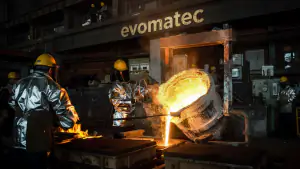
INVESTMENT CASTING FOUNDRY
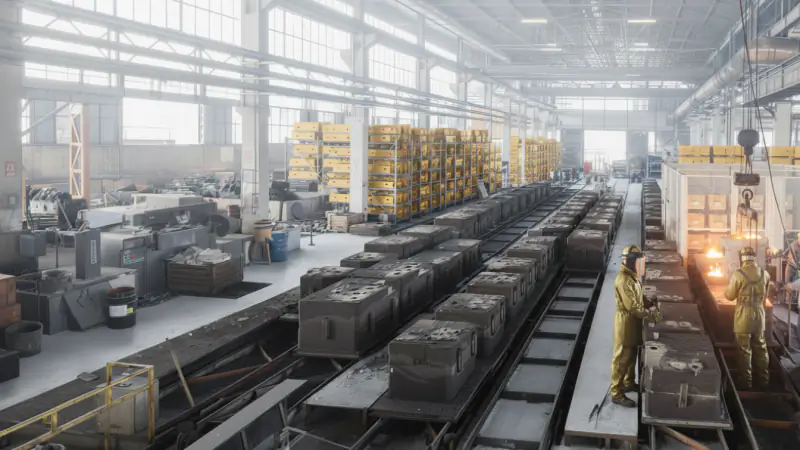
Investment Casting Foundry: Precision Casting, Processes, Quality, Costs and the Future of a High-End Casting Technology
An investment casting foundry stands for precision, surface quality and geometric freedom in the production of cast parts like almost no other process. Investment casting, also known as precision casting or the lost-wax process, enables complex components with fine contours, thin wall thicknesses and high repeatability, often with significantly reduced machining effort. At the same time, investment casting is not a simple standard process, but a strictly controlled process chain consisting of pattern production, ceramic shell building, dewaxing, burnout, casting, finishing and documented inspection. Anyone who orders or produces investment cast parts deliberately chooses a technology in which process control, cleanliness and verifiable quality are central.
This blog article by Evomatec provides a well-founded and at the same time practice-oriented overall presentation of investment casting production. It covers technology and functional principles, typical applications and industries, historical development, key advantages and limitations, cost logic, quality inspection methods, common defect patterns, and relevant future perspectives. Technically related terms such as precision casting, lost-wax process, investment cast parts, investment casting process, ceramic shell, wax pattern, gating tree, casting cluster, shell mould, surface roughness, dimensional accuracy, heat treatment, machining and non-destructive testing are correctly and contextually integrated to ensure broad semantic coverage in line with modern search and information requirements and to optimally support Evomatec’s service offering.
Understanding an Investment Casting Foundry: Definition, Differentiation and Objectives
Investment casting is a casting process in which a pattern, usually made of wax, is enclosed in a ceramic shell in multiple steps. After hardening, the wax is melted out, the ceramic mould is fired, and then filled with molten metal. After solidification, the shell is removed, the castings are cut off and finalized. The result is investment cast parts with high detail fidelity and very good surface quality.
The objective of an investment casting foundry is not only to manufacture a casting, but to reproducibly achieve defined requirements for geometry, tolerance, surface, material condition and inspection evidence. Investment casting is therefore particularly attractive when components are complex, require high functional integration, or when the total of machining, assembly and finishing can be reduced through a casting-optimized solution.
Investment Casting Compared to Sand Casting, Permanent Mould Casting and Steel Casting
Investment casting differs significantly from classic sand casting processes. Sand casting is often more cost-effective for large parts and coarser tolerance requirements, but it does not automatically achieve the fineness, surface quality and detail fidelity of investment casting. Permanent mould casting uses metallic reusable moulds and is very economical for suitable alloys and high volumes, but is limited for highly complex internal geometries, undercuts and delicate details. Steel casting is a material category rather than a process, but compared to the investment casting chain it can often imply higher wall thicknesses, different mould systems and different cost and inspection efforts.
Investment casting is particularly advantageous when precise contours, delicate structures, low finishing effort and high repeatability are the priority, and when the added value lies in component function rather than solely in raw material price.
Historical Development: Why the Lost-Wax Process Still Sets Standards Today
The basic principle of investment casting has been known for a long time: a pattern is embedded in a mould, later removed, and the resulting cavity is poured. Industrial investment casting has continued to evolve over decades, especially through advances in ceramic mould materials, controlled melting practice, temperature management, vacuum or protective-gas processes, automation and inspection technology. Modern investment casting foundries today combine process know-how, reproducible recipes for ceramic shells, defined firing profiles and robust inspection chains to deliver highly consistent results.
Materials in Investment Casting: Alloys, Properties and Selection Criteria
Investment casting is used for a wide range of metals and alloys. Material selection is based on mechanical loading, corrosion requirements, temperature range, wear profile, weight targets, machining strategy and normative requirements.
Typical Material Groups for Investment Cast Parts
Depending on the application, unalloyed, low-alloy and high-alloy steels as well as corrosion-resistant materials are used. Many non-ferrous alloys are also cast when weight, corrosion resistance or thermal conductivity are the priority. The key is that not only the alloy matters, but also the process condition: solidification conditions, heat treatment and finishing determine the final property profile.
Material Selection in Practice: Not Only Strength Matters
In practice, strength and hardness are only part of the decision. For functional components, toughness, fatigue strength, tightness, surface quality, dimensional stability and machinability are often just as important. Investment casting is particularly strong when component function is supported by precise geometry and good surface quality and when downstream process steps can be reduced as a result.
Process Chain in an Investment Casting Foundry: Step by Step to the Precision Casting
Investment casting production is a sequence of clearly defined steps. Each step influences defect susceptibility, dimensional accuracy, surface quality, cost and lead time.
Component Design and Casting-Friendly Engineering
Investment casting starts with design and specification. Wall thicknesses, radii, transitions, feeding and gating concepts, tolerances, machining allowances and inspection requirements must be defined early. A typical investment casting advantage arises when functions are integrated, part count decreases, or when extensive machining and assembly are reduced.
Here, project experience is a measurable advantage. In comparable industrial projects, Evomatec incorporates the understanding that inspections and test workflows must not only be formally planned, but implemented with the highest care in terms of quality and CE-compliant safety. This approach, shaped by many customer projects, strengthens process stability and verifiable compliance.
Manufacturing the Wax Patterns
Investment casting typically works with wax patterns. These are produced by injecting wax into a tool, often designed as an injection mould. Pattern quality is crucial: surface defects, dimensional deviations or air inclusions in the wax are transferred to the casting. Therefore, wax formulation, injection parameters, tool temperature control and cooling conditions are controlled.
Depending on the part, multiple wax patterns are assembled into a gating tree. This gating tree later determines filling behavior and solidification. Careful design reduces turbulence, minimizes oxides and supports directional solidification.
Building the Ceramic Shell
Ceramic shell building is a core element of an investment casting foundry. The wax pattern is repeatedly dipped into a ceramic slurry and stuccoed with grains until the desired shell thickness and stability are achieved. Drying times, humidity, temperature, recipe and layer sequence are critical. The goal is a shell that is stable and castable while maintaining the pattern’s detail fidelity and can be removed in a controlled manner during knockout.
Dewaxing and Burnout
After shell building, the wax is melted out. The dewaxing process must be controlled so that the shell does not crack and no residues remain. The ceramic mould is then fired. This burnout removes remaining wax, stabilizes the shell and sets the temperature conditions for pouring. The firing profile influences mould strength, gas generation and the risk of surface defects.
Melting and Pouring: Temperature Control, Cleanliness and Filling Strategy
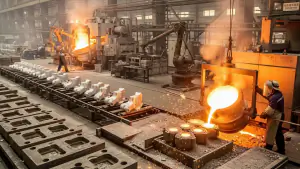
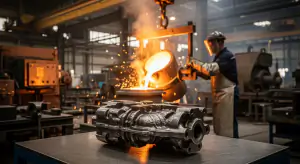
During pouring, it is decided whether the ceramic mould is filled calmly and whether surface defects, inclusions or porosity form. Temperature windows, melt cleaning, slag management and, where applicable, protective atmosphere are key levers. Preheating the shell also plays a major, as it influences flowability, surface quality and solidification.
A precisely designed gating and feeding system controls how the metal flows and how shrinkage is fed. Especially with delicate geometries, calm, controlled mould filling is essential to avoid defects.
Solidification, Cooling and Knockout
After pouring, the metal solidifies in the ceramic mould. Cooling conditions influence microstructure, residual stress state and dimensional accuracy. After sufficient cooling, the ceramic is removed, often by mechanical or thermal methods. The parts are then separated from the gating tree and the gate areas are finished.
Finishing, Heat Treatment and Machining
Investment cast parts are often near-net-shape, but depending on the application, heat treatment and machining are required. Heat treatment is used to set strength, toughness, hardness distribution and residual stress condition. Machining produces precise functional surfaces, sealing surfaces, fits and threads. The major advantage of investment casting is often that machining effort is significantly reduced compared to alternative manufacturing routes because contours are already created by the casting process.
Quality Assurance in an Investment Casting Foundry: Inspection Methods, Documentation and Process Reliability
Investment casting is often used in function-critical and safety-critical applications. Accordingly, quality assurance is an integral part of the process chain.
Dimensional Inspection and Surface Evaluation
Dimensional accuracy is a core topic in investment casting. Depending on the component, defined measurement strategies are used to verify critical dimensions, datum systems and form deviations. Surface evaluation is also central because investment casting is often chosen for its surface quality. Surface condition affects tightness, coating, friction and component function.
Material Verification, Microstructure and Mechanical Properties
Depending on the specification, chemical analysis, mechanical testing and microstructural examinations are required. The goal is robust evidence that the material and process condition meet the requirements. Especially for highly loaded parts, the combination of mechanical properties and documented process control is a key decision criterion.
Non-Destructive Testing and Leak Testing
Depending on the risk profile and application, investment cast parts are inspected non-destructively, for example for internal discontinuities or surface cracks. For media-carrying components, leak and pressure tests are particularly relevant. A good inspection plan is function-oriented: it focuses on critical zones, provides clear evidence and remains economically feasible.
From many years of experience in different customer projects, it often becomes clear that not only the test method matters, but also the organization of inspection. In comparable project contexts, Evomatec ensures that inspections are carried out with the highest care and that quality and CE-compliant safety are consistently considered. This ensures audit-ready workflows and reliable results.
Typical Defect Patterns in Investment Casting: Causes, Effects and Prevention
Investment casting is not free of defect patterns. However, many risks can be significantly reduced through robust process control and casting-friendly design.
Porosity and Shrinkage Defects
Shrinkage-related defects occur when feeding and solidification control are insufficient or when hot spots are unfavorably located in the geometry. Prevention is achieved through casting-friendly design, correct gating and feeding design, and controlled cooling.
Inclusions and Oxide Films
Inclusions are caused by slag, oxides or reaction products. Calm mould filling, clean melt practice, good ladle management and stable process windows reduce this risk.
Surface Defects and Reaction Zones
Surface defects can result from the ceramic shell, firing profile, temperature control or chemical reactions. Shell recipes, drying, burnout and controlled pouring parameters are key levers here.
Cracks and Distortion
Cracks and distortion are often caused by residual stresses, unfavorable geometry transitions, uneven cooling or unsuitable heat treatment. Prevention is achieved through design optimization, controlled process windows and matched heat treatment.
Applications and Industries: Where Precision Casting Is Especially Strong
Investment casting is used when complexity, functional integration, surface quality and precision are economically decisive.
Mechanical Engineering and Plant Engineering
Investment cast parts enable function-integrated components, complex housing contours, levers, brackets, nodes and components with complex internal contours. The benefit is often reduced assembly and machining effort with simultaneously high component quality.
Pumps, Valves and Fittings
In housings, valve bodies and media-carrying components, the combination of dimensional accuracy, surface quality and inspection concept is particularly relevant. Precision casting can support sealing surface geometry and reduce machining, provided the specification and process control are properly aligned.
Energy, Process Industry and Functional Parts with Temperature or Media Requirements
Investment casting becomes attractive where material requirements, detail fidelity and verification come together. Especially in applications with complex flow channels or function-integrated structures, investment casting demonstrates its strengths.
Series Components with High Repeatability
With suitable volumes, investment casting can be very economical when tool costs are amortized over the production run and when reduced finishing accelerates the overall process.
Advantages and Disadvantages: Evaluating Investment Casting Realistically
Investment casting offers very high detail fidelity, good surface quality, good repeatability and often a significant reduction in machining and assembly. Complex geometries can often be realized in one piece, reducing part count and sources of error.
At the same time, investment casting is process-intensive. Tooling costs for wax patterns, shell building, drying times, firing processes and inspection effort influence price and lead time. For very large parts or coarse tolerance requirements, another casting process may be more economical. Investment casting is therefore especially optimal when the added value lies in component function, precision and process simplification.
Costs in an Investment Casting Foundry: What Determines the Price
The cost structure in investment casting consists of several factors. Tool and pattern costs are relevant, especially for complex wax tools. Shell building is material- and labor-intensive. Drying and firing times influence throughput and lead time. Melting and pouring costs depend on alloy, process control, yield and quality requirements. Finishing, heat treatment and machining vary depending on functional surface share. Inspection and documentation scope can account for a substantial share, especially for non-destructive testing and approvals.
Economic efficiency often results from a total-system view: investment casting often reduces machining, assembly and logistics effort. If this leads to fewer process steps, fewer parts and fewer risks, investment casting is often superior across the entire value chain.
Experience from many industrial projects also shows that stability in the inspection process protects costs and schedules. In comparable projects, Evomatec contributes the experience that inspections should be organized with the highest care and with consistent consideration of CE-compliant safety in order to reduce rework, delays and approval risks.
Future Perspectives: Digitalization, Automation and Sustainability in Investment Casting
The future of investment casting is shaped by three main fields. First, digitalization and simulation to optimize gating and solidification design faster and prevent defects early. Second, automation in pattern handling, shell building, knockout and inspection to increase repeatability. Third, sustainability, especially through more efficient melting processes, better material cycles, lower scrap rates and optimized process control.
In parallel, requirements for traceability, documented quality and safe inspection environments are increasing. Especially for inspection technology, handling and documentation-intensive processes, CE-compliant safety is becoming an increasingly important differentiator. In this context, it makes sense to design inspection workflows so that they are reliably implementable in daily operations, clearly traceable and executed with a high level of care, as is anchored as a quality principle in many industrial projects in the Evomatec environment.
FAQ About Investment Casting Foundries
What is the greatest advantage of an investment casting foundry compared to classic casting processes
The greatest advantage is the combination of detail fidelity, good surface quality and high repeatability for complex geometries. This often significantly reduces machining and assembly effort
Which components are especially suitable for investment casting
Investment casting is particularly suitable for complex, function-integrated components with fine contours, thinner wall thicknesses and high requirements for surface quality and dimensional accuracy, for example in valve technology, mechanical engineering and function-critical components
Which factors determine lead time in investment casting
Lead times are strongly influenced by tooling and pattern production, shell building with drying times, firing processes, heat treatment and the scope of inspection and documentation. An early, aligned specification accelerates the process chain
Which inspections are common for investment cast parts
Depending on the application, dimensional and surface inspection, material verification, mechanical tests and non-destructive testing as well as, for media-carrying parts, leak or pressure tests are common. The key is a function-oriented inspection plan
Request a free consultation: info@evomatec.de