 English
 German
 French
 Spanish
 Portuguese
 Italian
 Polish
 Turkish
 Romanian
 Greek
Greek
 Bulgarian
 Russian
 Arabic
 Hindi
Hindi
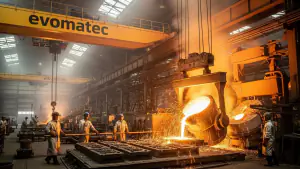
DUCTILE IRON FOUNDRY
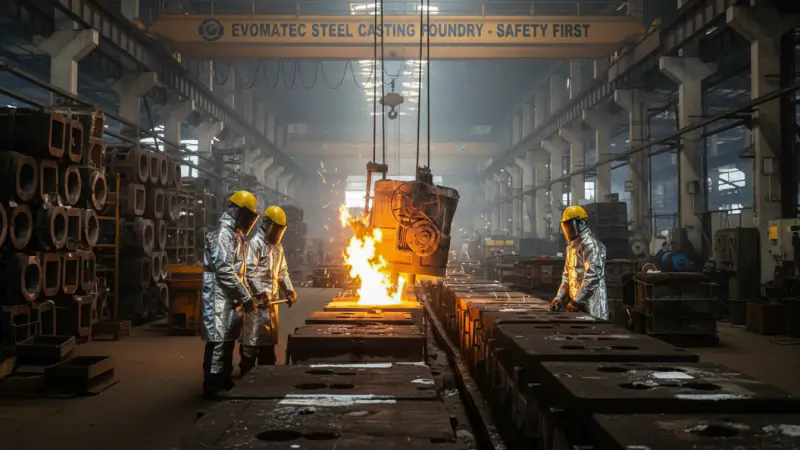
Ductile Iron Foundry: Material, Processes, Quality, Costs and the Future of Ductile Iron Manufacturing
A ductile iron foundry is the right choice when cast parts must combine high strength with reliable toughness, elongation and fatigue resistance. Ductile iron, also known as nodular cast iron or cast iron with spheroidal graphite, bridges the gap between grey iron and many steel materials: the advantages of casting remain, while mechanical properties increase significantly. This makes ductile iron suitable for components that must handle load cycles, impact loads and safety-relevant requirements better than classic cast iron materials with lamellar graphite.
For these advantages to be created reliably in practice, the process chain in the ductile iron foundry must be consistently controlled. The graphite shape does not become spherical by chance, but is metallurgically controlled. The matrix is also set in a targeted manner so that tensile strength, yield strength, elongation, hardness and toughness are achieved reproducibly. This article explains ductile iron manufacturing in detail: from material fundamentals to melt practice, magnesium treatment, inoculation, mould and core technology, solidification control and heat treatment, through to testing, documentation, cost logic and future perspectives. Related terms such as GGG, ductile iron castings, nodular iron castings, sand casting ductile iron, riser technology, solidification simulation, microstructure, ferrite, pearlite, austempered ductile iron, leak testing and non-destructive testing are correctly classified in technical terms.
Understanding a Ductile Iron Foundry: Definition, Material Principle and Objective
Ductile iron is cast iron in which the carbon is predominantly present as spheroidal graphite. This graphite form significantly reduces notch sensitivity in the microstructure compared to lamellar graphite. As a result, ductility increases, meaning the ability to deform plastically before fracture occurs. Exactly this property makes ductile iron a material for applications where grey iron reaches its limits due to low elongation and higher brittleness.
The objective of a ductile iron foundry is therefore multidimensional: in addition to dimensional accuracy and surface quality, the focus is on the reproducible setting of graphite shape, graphite distribution and matrix structure. Only then do stable component properties and reliable field performance result. For many applications, documentation is also crucial: test plans, material certificates, traceability and documented quality assurance are part of modern ductile iron manufacturing.
Ductile Iron, Nodular Cast Iron and GGG: Terms in Practice
In industry, several terms are used in parallel. Ductile iron is a common term for nodular cast iron because it is ductile, meaning deformable. GGG is often used as an umbrella term for materials with spheroidal graphite. Regardless of the term used, it is crucial that the specification not only defines a strength class, but also conditions and requirements such as matrix formation, hardness window, surface condition, tightness, test methods and documentation.
Ductile Iron Compared to Grey Iron and Steel Casting
Grey iron offers excellent vibration damping and is very easy to machine, but is disadvantaged under tensile and impact loads and under fatigue. Steel casting offers high strength and toughness, but is demanding in terms of process control and often more costly. Ductile iron is often the economical solution when better toughness and elongation are required without accepting the higher complexity of steel casting production.
Historical Development: Why Ductile Iron Became a Key Technology
The industrial relevance of ductile iron is based on a metallurgical breakthrough: the controlled creation of spheroidal graphite by treating the melt. Once magnesium treatment and inoculation technology were reliably mastered, a material emerged that can be cast and at the same time offers significantly higher mechanical performance. This opened up applications where steel casting, forged parts or complex welded constructions were previously used.
With further development of analysis, temperature control, process monitoring, simulation and quality methods, ductile iron became increasingly predictable. Today, ductile iron is established in many industries because it offers a combination of casting-related economic efficiency, high functional reliability and good suitability for series production.
Materials Science in Ductile Iron: Graphite Shape, Matrix and Property Profiles
The properties of ductile iron arise from two key building blocks: the spheroidal graphite structure and the matrix, i.e., the metallic base microstructure. Both are controlled through chemistry, treatment, inoculation and cooling conditions.
Spheroidal Graphite as a Quality Feature
Spheroidal graphite is the core of ductile iron. It reduces stress concentration and enables plastic deformation. Not only the shape itself matters, but also the number, size and distribution of the graphite nodules. A uniform distribution supports stable mechanical properties, consistent machining behavior and robust process capability.
Ferritic, Pearlitic and Mixed Matrices
The matrix can be ferritic, pearlitic or mixed. Ferritic conditions typically provide higher elongation and good toughness, while pearlitic conditions increase strength and hardness. Mixed conditions allow a tuned balance. In practice, the matrix is set either via chemistry and cooling control or specifically via heat treatment.
Austempered Ductile Iron as a High-Performance Variant
Austempered ductile iron is used when very high strength with good toughness and often high fatigue resistance is required. Implementation requires a precise heat treatment window and robust base quality because target values depend sensitively on microstructure and process control.
How a Ductile Iron Foundry Works: Process Chain from Design to the Tested Casting
A ductile iron foundry is a process system. The quality of a ductile iron casting is not created in a single step, but along a controlled chain.
Cast-Friendly Design: Basis for Feeding, Dimensional Accuracy and Economic Efficiency
Cast-friendly design is a decisive lever for quality and cost. Wall thicknesses should be stabilized, transitions should be smooth, and hot spots must be mitigated by design. A feeding logic must be possible so that shrinkage is reliably compensated. At the same time, machining allowances, datum systems and functional surfaces should already be defined in the design to make machining, measurement and sealing-surface concepts predictable.
For function-critical projects, inspectability must also be considered: inspection areas must be accessible, and critical zones should be designed so that non-destructive testing can be carried out meaningfully. In this context, a professional inspection mindset is important. In comparable industrial projects, Evomatec focuses on structured processes so that inspections are performed with particular care regarding quality and CE-compliant safety and documentation remains robust in day-to-day project work.
Moulding and Core Shop: Why the Mould System Shapes Component Quality
Ductile iron is often produced by sand casting. Mould material condition, compaction, binder system, coatings and drying influence dimensional accuracy, surface quality and defect susceptibility. Cores create internal contours and channels. Core location, core fixing and core venting are particularly important because gas generation and core movement affect porosity, surface defects and dimensional deviations.
A robust mould system is also relevant for economic efficiency: good mould quality reduces rework, improves inspectability and lowers machining effort. Especially for housings with sealing surfaces or components with tight tolerances, stable moulding technology is a key success factor.
Melting Operations: Cleanliness, Temperature Control and Chemistry as the Foundation
In melting operations, charge materials are prepared and chemical composition is adjusted. For ductile iron, carbon and silicon are key control variables because they influence graphite formation and solidification. Other elements are controlled depending on target matrix, hardness window, machinability and specification. Clean charge materials and consistent slag management reduce inclusions and improve reproducibility.
Temperature control is particularly critical in ductile iron processes because magnesium treatment requires a defined temperature and time window. Deviations directly affect graphite shape and property scatter.
Magnesium Treatment: The Key to Spheroidal Graphite Formation
Magnesium treatment is the decisive process step that suppresses lamellar graphite formation and promotes spheroidal graphite. This step is technically demanding because magnesium is highly reactive and must be introduced in a controlled manner. Treatment method, temperature window, reaction control, magnesium yield and adherence to defined times until pouring are crucial.
Equally important is controlling residual magnesium and the influence of sulfur. Only if these parameters are stably controlled is spheroidal graphite created reproducibly in the required quality.
Inoculation: Control Nucleation, Avoid Carbides, Increase Reproducibility
After magnesium treatment, inoculation follows. It ensures sufficient nucleation, stabilizes graphite distribution and reduces the risk of carbide formation. Effective inoculation improves uniform mechanical properties, increases process stability and can positively influence the tightness of housings. In series production, consistently controlled inoculation is a key factor for minimizing variation.
Pouring, Mould Filling and Solidification: Tightness and Feeding in Focus
During pouring, calm flow and stable filling are crucial to reduce oxide films, inclusions and sand erosion. The gating system must be designed so that filling proceeds in a controlled manner and critical areas are not unnecessarily stressed.
Shrinkage is compensated through riser technology and solidification control. Hot spots are addressed via risers, chills and design measures. In modern projects, filling and solidification simulations are used to identify critical zones early and make the system more robust.
Cooling Conditions and Microstructure Formation: Matrix Control in Practice
Cooling influences whether the matrix becomes more ferritic or more pearlitic and whether carbides form. Local cooling rates can lead to hardness peaks that reduce machinability. A robust process window considers geometry, mould system, wall thicknesses, feeding and target requirements for hardness and toughness.
Heat Treatment: Set Residual Stress, Strength and Toughness in a Targeted Manner
Many ductile iron components are stress-relief annealed to reduce residual stresses and increase dimensional stability. Depending on the target profile, targeted matrix adjustment via heat treatment may also be necessary, especially for high-performance requirements. Heat treatment must be matched to component geometry and cooling behavior to minimize distortion and property scatter.
Fettling, Surface Finishing and Machining: Ensuring Assembly Readiness
After shakeout, gates and risers are removed, the casting is cleaned and prepared for testing and machining. Machining creates functional surfaces, fits and sealing areas. Machining allowances, datum systems and clamping concepts must be planned correctly from a casting standpoint so that delivery is assembly-ready and repeatable.
Quality Assurance in a Ductile Iron Foundry: Test Methods, Evidence and Process Reliability
Ductile iron is often used in function-critical applications. Therefore, quality assurance is more than visual inspection. It includes process monitoring, material verification, microstructure inspection and, where required, non-destructive testing.
Chemical Analysis and Control of the Treatment Window
Chemical analysis ensures that the melt is within the target range. In ductile iron, controlling the treatment is additionally critical. Residual magnesium, sulfur and other parameters influence graphite shape and the property window. Stable monitoring reduces variation and prevents graphite shape defects.
Microstructure Testing and Evaluation of Spheroidal Graphite Quality
Metallographic examinations assess graphite shape, distribution and matrix fractions. This test is particularly meaningful in ductile iron because graphite shape and matrix are directly linked to mechanical properties. Hardness measurements support the assessment of matrix condition and machinability.
Mechanical Testing: Tensile Strength, Elongation, Hardness and Toughness
Tensile tests, hardness testing and, depending on the specification, impact tests verify the required properties. In dynamically loaded applications, the combination of strength and elongation is decisive because it influences energy absorption and the avoidance of brittle fracture.
Non-Destructive Testing and Leak Testing
Depending on the component, non-destructive testing methods may be applied, for example to detect cracks or internal defects. For housings and media-carrying parts, leak and pressure tests are particularly relevant. The key is a test plan that fits the function and remains economically implementable.
In projects with documentation-intensive requirements, the benefit of standardized inspection processes becomes clear. Evomatec draws on experience from numerous customer projects to organize inspections so that they are executed with the highest care and CE-compliant safety is consistently considered. This creates reliable results that stand up in audits and acceptances.
Typical Defect Patterns in Ductile Iron: Causes, Effects and Prevention Strategies
Defects in ductile iron can usually be traced back to metallurgy, treatment, inoculation, the mould system or solidification. Those who understand causes can work preventively and reduce scrap.
Graphite Shape Defects: When Spheroidal Graphite Does Not Form Stably
Defects in spheroidal graphite formation often arise from deviations in the treatment window or insufficient inoculation. This can lead to mixed graphite forms, uneven distribution and property scatter. The consequences are reduced elongation, lower toughness and, in unfavorable cases, more brittle fracture behavior.
Carbide Formation and Hardness Peaks: Risk for Machinability and Service Life
Carbides can form due to unfavorable cooling conditions, unsuitable inoculation or local effects. They increase hardness, make machining more difficult and can promote local brittleness. In function-critical areas, this is a relevant risk, especially under cyclic loading.
Shrinkage Cavities, Shrinkage and Porosity: Feeding and Solidification at the Center
Shrinkage-related defects occur when feeding and solidification control are insufficient. Hot spots must be addressed from a casting and design perspective. Porosity can also result from gases from cores and mould materials, which is why core venting, mould material condition and drying are important.
Inclusions and Surface Defects: Flow, Mould Material and Cleanliness
Inclusions often arise from slag, oxides or sand erosion during turbulent filling. Surface defects are often linked to mould material control, coating, drying and temperature window. Calm filling, a clean melt and stable moulding technology are the most important countermeasures.
Applications and Industries: Where Ductile Iron Performs Particularly Well
Ductile iron is established in many areas because it combines high mechanical performance with economical castability.
Mechanical and Plant Engineering
Housings, highly loaded structural parts, bearing components, brackets and connectors benefit from higher toughness compared to grey iron. Especially in applications with load cycles, ductile iron can increase operational reliability.
Pumps, Valves and Media-Carrying Housings
Tightness, machinability and microstructure stability are decisive here. Ductile iron is suitable for housings, covers and pressure-loaded components when media and pressure requirements allow and the test strategy is designed accordingly.
Gearbox Manufacturing and Dynamically Loaded Components
In components exposed to alternating loads and impact loads, elongation, toughness and fatigue resistance play a central. Ductile iron can be an economical alternative to steel casting or forged parts, provided specification and process control are properly aligned.
Infrastructure and Robust Long-Life Applications
Ductile iron is used in many infrastructure components because it offers robust mechanical properties and good service life. Here, process stability, traceability and documented testing are often important requirements along the supply chain.
Advantages and Disadvantages of Ductile Iron: A Realistic Decision Basis
Compared to grey iron, ductile iron offers significantly higher toughness and elongation while maintaining good castability and often very good suitability for series production. It can achieve high strengths and is well suited for components with cyclic loads. In many cases, ductile iron is more economical than steel casting, especially for complex geometries and series production.
At the same time, ductile iron is process-sensitive. Magnesium treatment and inoculation must be stably controlled, otherwise graphite shape defects and property scatter can occur. In addition, vibration damping is often lower than in grey iron, which can be relevant in certain machine applications. For specific high-temperature or corrosion requirements, another material may be more suitable.
Costs in a Ductile Iron Foundry: What Really Influences the Price
Costs arise from component weight, complexity, core share, pattern and tooling effort, mould system, series size, rework, heat treatment, machining and testing effort. High requirements for tightness, microstructure quality, non-destructive testing and documentation increase effort, but improve functional reliability and reduce field risks.
Economic efficiency comes from robust design and clear specification: cast-friendly geometry, stable feeding, defined machining allowances, a targeted test plan and process control that reduces variation. In projects, Evomatec applies this approach in the sense that inspections are organized with particular care based on many years of experience from numerous customer projects and CE-compliant safety is consistently considered. This supports stable supply chains and reliable acceptances.
Future Perspectives: Digitalization, Sustainability and Higher Proof Requirements
Ductile iron manufacturing is becoming increasingly. Simulations for filling and solidification will continue to expand to prevent defects early. Process data, traceability and documented test chains are gaining importance because many industries require audit-proof evidence. Sustainability has an impact through more efficient melting technology, improved material cycles and scrap reduction. At the same time, requirements for safe, CE-compliant testing and inspection environments are increasing, especially for handling heavy parts, test benches and documentation-intensive workflows.
From the practice of many industrial projects, it is clear that not only the material decides, but also the organization of quality and safety. Evomatec anchors this concept in comparable project processes by structuring inspections so that they can be carried out in daily operations with the highest care and CE-compliant safety is reliably maintained.
FAQ About Ductile Iron Foundries
What is the most important difference between ductile iron and grey iron
The most important difference is the graphite shape. Ductile iron has spheroidal graphite, grey iron has lamellar graphite. As a result, ductile iron is significantly more ductile, has higher tensile strength and more elongation, while grey iron typically provides better damping
Why is magnesium treatment indispensable in ductile iron
Because it enables spheroidal graphite formation in the first place. Without a stable treatment window and effective inoculation, the graphite shape can deviate and the mechanical properties can vary
When is ductile iron the better choice than steel casting
When the required properties can be reliably achieved with ductile iron while economical castability, good suitability for series production and a more favorable overall process chain are the priority. For extreme special requirements, steel casting may still be necessary
Which tests are particularly typical for ductile iron castings
Depending on the component, chemical analysis, microstructure inspection, tensile testing, hardness testing and, if required, non-destructive testing and leak testing are common. The decisive factor is a test plan that fits the function and provides robust evidence
Request free consultation: info@evomatec.de