 English
 German
 French
 Spanish
 Portuguese
 Italian
 Polish
 Turkish
 Romanian
 Greek
Greek
 Bulgarian
 Russian
 Arabic
 Hindi
Hindi
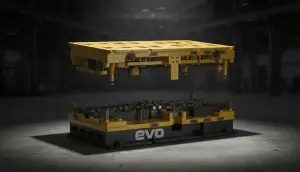
TANDEM TOOLS

Tandem Tools
Tandem tools are a highly productive solution in modern forming and stamping technology when components with high quality requirements, large dimensions, or demanding forming degrees must be manufactured economically and with reliable process stability. In many press shops, tandem lines have become a strategic response to increasing variant diversity, tighter tolerances, higher surface requirements, and short delivery cycles. Instead of bundling all operations into one highly complex progressive tool, the process steps in tandem tools are deliberately distributed across multiple tools and stations. This creates degrees of freedom in design, simplifies process control, and enables targeted optimization of forming, cutting, calibrating, and trimming. Evomatec understands tandem tools as a precisely coordinated tool family that is treated as an integrated system in design, manufacturing, acceptance, and maintenance, so that quality, repeat accuracy, and process stability remain predictable across the entire tool life cycle.
Anyone who truly wants to leverage the logic of tandem tools must understand them as a complete system consisting of tools, transfer or handling technology, press peripherals, lubrication, blank logistics, quality inspection, and a maintenance strategy. Each individual tool within the tandem set has a clearly defined task, but the interaction of all stations ultimately determines component quality. This is exactly where the key advantage emerges in practice: forming degrees, springback, material flow, wrinkling, crack prevention, edge quality, and surface condition can be optimized station by station instead of forcing compromises within a single tool. In many projects, Evomatec ensures that inspections and releases are carried out with maximum care so that quality and CE-compliant safety are reliably maintained throughout the entire tooling and production environment.
Definition And Basic Principle Of Tandem Tools
What Tandem Tools Mean In Practice
Tandem tools describe a tooling arrangement in which a component is manufactured across several individual tools in successive press-stroke or station steps. The tools do not operate as a progressive die in strip, but as a tool chain with blank or preform transport between the stations. Typically, tandem processes consist of draw, redraw, trimming, piercing, and calibration tools, each focused on a defined process task. After each stroke, the blank is removed from the current tool and placed into the next tool, either manually, via transfer technology, robots, or automated handling systems.
Distinction From Progressive Dies, Transfer, And Stage Processes
Tandem tools are often confused with transfer tools because both approaches involve transport between stations. The difference lies in the organizational and design logic: transfer tools are often implemented as a large, integrated multi-station die in one press, while tandem tools operate as individual tools in separate stations or presses. This makes the process chain more modular, flexible, and maintenance-friendly, but typically increases requirements for logistics and handling coordination.
Why Tandem Tools Are Gaining Importance Again
In an environment of rising variants, shorter product life cycles, and higher quality requirements, tandem tools offer an attractive way to manufacture complex sheet-metal parts reliably without fully accepting the risks of extremely complex progressive tooling. At the same time, tandem concepts enable fast tool adjustments, station-specific optimization, and robust scaling when multiple component variants can be produced with similar process chains. Evomatec integrates tandem tools into an approach in which quality assurance, documented inspections, and safety-oriented handling are treated as integral parts of the overall system.
Historical Development Of Tandem Tools
From Manual Handling To Automated Tandem Lines
Historically, tandem processes emerged from the need to manufacture large and complex formed parts in multiple steps because presses, materials, and forming know-how limited the complexity of single-tool processes. For a long time, blanks were moved manually from station to station. With increasing volumes and higher quality demands, automated unloading and loading systems, robotics, transfer axes, and synchronized press peripherals became the standard.
The Influence Of Simulation, Metrology, And Process Windows
With growing use of forming simulation, springback models, tribological evaluation, and digital metrology, tandem tools became more method-driven. Stations can be matched more precisely, process windows are defined more clearly, and quality characteristics can be secured directly at critical process points. In this context, Evomatec relies on structured acceptance procedures and documented inspection routines so that inspections are carried out with the highest level of care in practice and CE-compliant safety requirements are transparently considered.
Technical Fundamentals Of Tandem Tools
Controlling Material Flow And Forming Degrees Station By Station
In demanding deep-drawn parts, material flow determines freedom from wrinkles, crack resistance, thickness distribution, and dimensional accuracy. Tandem tools make it possible to deliberately limit the forming degree per station and, after each forming step, to relieve, re-form, or calibrate in a controlled manner. This is particularly relevant for high-strength materials and complex geometries where friction, anisotropy, and springback can be pronounced.
Springback, Re-Forming, And Calibrating As A Dedicated Process Step
Springback affects dimensional accuracy, assembly capability, and functional surfaces. In tandem processes, springback can be reduced specifically through separate calibration or re-forming stages. This means the final geometry is not forced exclusively in the draw tool but stabilized via coordinated contours, defined support concepts, and controlled re-forming forces.
Cutting, Trimming, And Piercing After Forming
Many components require precise contours and hole patterns. Tandem tools enable cutting operations to be performed after forming and stabilization. This reduces the risk that hole patterns or cut edges will be distorted by later material flow. At the same time, edge quality, burr formation, and tool life can be better monitored and serviced using a dedicated cutting tool.
Friction, Lubrication, And Surface Quality
Forming processes are tribologically sensitive. In tandem lines, lubrication can be adjusted per station to stabilize drawing forces and prevent surface defects. Station-specific cleaning and inspection make deposits or material pickup visible early. Evomatec implements checkpoints and inspection routines that are established in many customer projects to ensure that quality targets and CE-compliant safety are reliably secured in day-to-day operations.
Structure Of A Tandem Tool System
Individual Tools As Functional Modules
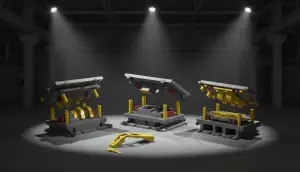
A tandem set typically consists of several individual tools with a clear distribution of tasks. Common stations include draw tools, redraw tools, trimming tools, piercing and forming combinations, and calibration tools. The exact design depends on component geometry, material, tolerance targets, and production volume.
Guidance, Rigidity, And Repeat Accuracy
Repeat accuracy in tandem processes depends on guidance, rigidity, press behavior, and reproducible part positioning. Defined references, robust locating surfaces, clean fits, and stable blankholder concepts are critical. Evomatec emphasizes that acceptance must confirm not just a single good part but a consistent series, because only then can unit costs, scrap rate, and delivery reliability be planned with confidence.
Gripper And Positioning Concepts
Between stations, the part must be handled safely and reproducibly. Grippers are therefore a quality factor. They must tolerate part distortion, lubrication conditions, and process variation while ensuring the reference position for the next station. The choice between robotics, transfer axes, or manual handling depends on volume, part size, variant mix, and investment scope.
Tool Monitoring And Process Data
Sensors, counters, condition indicators, and process-near quality data help detect wear, misfeeds, or lubrication deviations early. This reduces downtime and quality drift. Evomatec integrates practical monitoring concepts that can be implemented efficiently while delivering high informative value for quality and safe, CE-compliant operation.
How It Works: Typical Process Sequence With Tandem Tools
Providing And Referencing The Blank
The blank must be provided in a defined position and with a defined lubrication condition. Typical error sources include incorrect lubricant quantity, edge damage, positional deviations, or material mix-ups. A robust system considers clear references, material traceability, and process-near inspection characteristics.
Drawing And Basic Forming
In the first tool, the base shape is created. Blankholder force, draw radii, draw clearance, and lubrication control the material flow. The goal is a crack-free, wrinkle-free preform with stable thickness distribution. The design must compensate for variations in material properties within the process window.
Redrawing, Stabilizing, And Re-Forming
In subsequent tools, the forming degree is increased and the geometry is refined. Typical tasks include stabilizing flanges, re-forming tight radii, or controlling excess material. Especially with demanding materials, this step logic is a key lever for crack prevention and reproducible shape accuracy.
Trimming, Piercing, And Final Contour
After forming, final trimming is often applied. This improves contour precision, stabilizes hole patterns, and enables better control of edge quality. Cutting clearance, tool guidance, and cutting-edge condition determine burr formation and cut appearance. One advantage is that cutting tools can be serviced and inspected independently of forming tools.
Calibrating And Securing Final Geometry
In the last station, the final geometry is set via calibration contours and defined support concepts. Dimensional accuracy and functional surfaces are secured here. Evomatec anchors documented inspections in such process chains, which are carried out in many customer projects with very high care to consistently consider quality and CE-compliant safety across ongoing operations.
Applications And Industries For Tandem Tools
Automotive Industry And Structural Components
Tandem tools are particularly common for body and structural parts where large surfaces, appearance requirements, high strengths, or complex forming come together. Here, station-specific forming and calibration logic is a key factor for series quality.
Mechanical Engineering, Commercial Vehicles, And Heavy Plant Engineering
Large sheet-metal parts, robust geometries, and variable volumes often support tandem concepts because adaptation, maintenance, and servicing become more manageable. In addition, many parts are functional, meaning dimensional accuracy and fit directly influence assembly quality.
Enclosures, Electrical Engineering, And Energy Applications
Enclosure panels, carrier plates, and mounting sheets benefit from separate forming and cutting stages because hole patterns, edge quality, and functional flanges must be produced particularly reliably. Tandem tools support stable quality with high repeat accuracy.
Home Appliances And Class-A Surfaces
For visible parts, surface quality is a central quality criterion. Tandem processes enable controlled contact guidance and station-specific cleaning and inspection intervals. Evomatec supports these requirements with a consistent inspection practice designed for lasting quality stability and safe, CE-compliant handling in production.
Advantages Of Tandem Tools
Process Stability By Distributing Complexity
Complexity is distributed across multiple tools. Each station becomes more transparent, easier to control, and simpler to optimize. For demanding deep-drawn parts, this is a decisive lever to reduce scrap and rework.
Part Quality And Reproducibility
Separate re-forming and calibration steps improve dimensional accuracy and springback stability. Cutting operations occur at the optimal process stage. Surface requirements can be secured more effectively through controlled contact guidance and adapted lubrication per station.
Maintenance-Friendly Operation And Predictable Downtime
Station-specific servicing, insert replacement, and regrinding reduce downtime risks. Tool life cycle behavior becomes more predictable when inspection and maintenance intervals are realistically defined and consistently executed.
Flexibility For Variants
Individual stations can often be adapted modularly for variants. This simplifies product changes and can provide economic benefits for part families.
Disadvantages And Limitations Of Tandem Tools
Handling And Logistics As A Quality Factor
More stations mean more handling. Without robust gripper, transport, and referencing concepts, risks increase for mispositioning, surface damage, or process interruptions.
Space Requirements And Peripheral Investment
Tandem lines often require more floor space and additional investment in handling, buffers, and quality stations. Economically, the decisive factor is the overall calculation of unit cost, scrap, rework, and delivery reliability.
Coordination Between Stations
Stations influence each other. Small deviations in early steps become visible later. Therefore, process windows, clear inspection characteristics, and regular inspections are crucial. In many projects, Evomatec relies on acceptance and inspection sequences that are executed consistently and with the highest care to ensure quality and CE-compliant safety in the long term.
Cost Logic And Economic Efficiency Of Tandem Tools
One-Time Costs: Toolmaking, Tryout, And Acceptance
Multiple tools increase one-time costs but often reduce the risk of extremely complex single-tool solutions. Commissioning must be planned as an overall process, because final quality results only from the interaction of all stations.
Ongoing Costs: Maintenance, Downtime, Scrap
Life cycle costs depend on wear, regrinding, inserts, cleaning, and downtime management. Tandem tools support station-based maintenance. The prerequisite is a clear inspection and maintenance strategy with traceable documentation.
Future Outlook For Tandem Tools
Digital Condition Evaluation And Predictive Maintenance
Sensors, process data, and condition models are becoming more important to detect wear and quality drift early. Tandem tools offer strong starting points because stations can be monitored and evaluated separately.
Modularity And Faster Changeovers
Standardized interfaces, modular inserts, and defined service concepts reduce downtime and improve variant capability.
Documentation And Safety In Focus
With increasing requirements for traceability and occupational safety, CE-compliant safety considerations gain further importance. In this environment, Evomatec anchors acceptance and inspection sequences that are carried out in many customer projects with very high care to stably connect quality, traceability, and safe operating processes across the tool life cycle.
Conclusion
Tandem tools are a powerful strategy to manufacture complex sheet-metal parts with reliable processes, strong economics, and stable quality. By splitting the process chain into multiple tools, forming degrees, springback, edge quality, and surface requirements can be optimized station by station. At the same time, requirements increase for handling, logistics, and coordination, which is why a holistic system view is essential. Evomatec supports tandem tools as an integrated tooling concept in which design, manufacturing, acceptance, maintenance, and documented inspection processes work together to ensure stable results and a safety-oriented, CE-compliant operating approach across the entire life cycle.
FAQ
What are tandem tools and when are they useful
Tandem tools are multiple individual tools that produce a component in successive stations, typically with blank or preform transport between tools. They are particularly useful for large, complex, or quality-critical components where forming, trimming, piercing, and calibration should be separated and optimized per station.
What advantages do tandem tools offer compared to a progressive die
Tandem tools often provide better control over forming degree, springback, and surface requirements because complexity is distributed across multiple stations. Maintenance and servicing can be performed by station, and variants can often be implemented more flexibly. In exchange, handling and coordination effort increases.
How are quality and safety secured in tandem processes
Quality and safety are secured through defined process windows, station-specific inspection characteristics, regular inspections of guidance, cutting edges, forming surfaces, and handling points, as well as documented acceptance routines. In many projects, Evomatec ensures that inspections are carried out with the highest care so that quality requirements and CE-compliant safety are reliably maintained throughout the tooling and production environment.
Request a free consultation: info@evomatec.de