
 English
 German
 French
 Spanish
 Portuguese
 Italian
 Polish
 Turkish
 Romanian
 Greek
Greek
 Bulgarian
 Russian
 Arabic
 Hindi
Hindi
HEAT TREATMENT OF CASTINGS / CAST PARTS
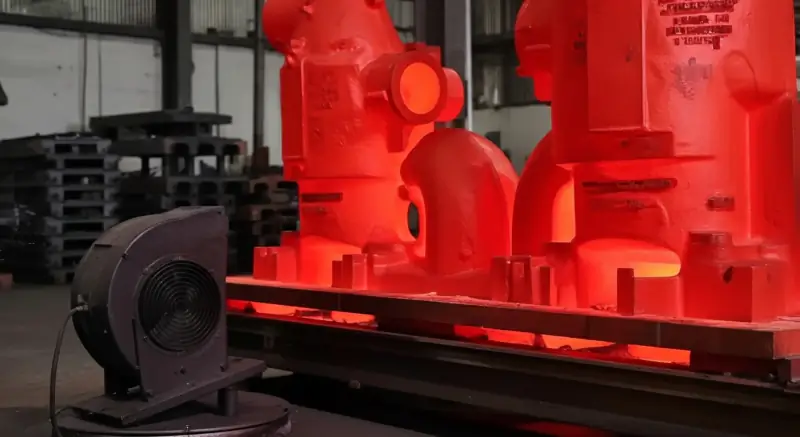
Heat Treatment of Castings / Cast Parts – The Key to Superior Casting Quality
Heat treatment determines the mechanical performance and service life of any casting.
During the casting process, stresses, porosity, and microcracks can develop — these are eliminated through precise heat treatment cycles.
Evomatec provides state-of-the-art furnace technology and comprehensive know-how for heat treating all types of casting materials with accuracy and repeatability.
Foundry, Foundry Model, Foundry Model Making, Foundry Model Making Sträfor, Foundry Model Making Styrofoam, Heat Treatment of Cast Parts, Heat Treatment of Castings, Foundry Technology, Heat Treatment in the Foundry Industry, Stress Relief Annealing of Castings, Normalizing of Cast Iron, Tempering of Steel Castings, Annealing of Cast Iron, Hardening of Casting Materials, Tempering Treatment of Castings, Heat Treatment of Gray Cast Iron, Heat Treatment of Ductile Iron, Heat Treatment of Steel Castings, Heat Treatment of Aluminum Castings, Furnace Technology for Casting Heat Treatment, Iron Casting HeatStress Relief Annealing of Castings – Dimensional Stability Without Deformation
During stress relief annealing, cast parts are heated to temperatures between 500 °C and 650 °C to relieve internal stresses created during solidification and cooling.
Evomatec employs computer-controlled furnaces with exact temperature management, ensuring uniform heating and cooling.
Advantages:
No deformation during subsequent machining
Improved dimensional stability
Extended component lifetime
Prevention of cracking during heat treatment
Normalizing of Cast Iron – Uniform Grain Structure for Consistent Quality
Normalization dissolves and reforms the microstructure of cast iron through controlled heating and slow cooling.
Evomatec optimizes this process via digitally managed annealing cycles, achieving uniform microstructures with consistent strength and hardness.
Applications:
Gray cast iron housings with high wall thickness
Machine components requiring stability
Precision elements with tight tolerances
The result is a stable and uniform cast structure resistant to mechanical fatigue and stress deformation.
Tempering of Steel Castings – Balancing Strength and Toughness
Tempering is a multi-step process combining hardening and annealing.
The steel casting is first heated to austenitizing temperatures (800–950 °C), then quenched, followed by controlled reheating to achieve the desired toughness.
Evomatec applies precise temperature profiles and sensor-controlled cooling rates to guide the transformation of the microstructure.
Results:
Optimal balance between hardness and ductility
High impact resistance and fatigue strength
Improved mechanical reliability for critical components
Hardening of Cast Materials – Maximum Surface Resistance
The hardening of cast materials aims to enhance surface wear resistance while maintaining a tough, ductile core.
Evomatec employs induction and furnace hardening technologies precisely matched to each alloy composition.
Typical Applications:
Gears, crankshafts, camshafts
Valve housings and hydraulic components
Tools and mold inserts
Through controlled heating and cooling, Evomatec achieves reproducible hardness levels for all casting materials — from gray iron to steel castings.
Tempering of Castings – Controlled Stress Reduction
After hardening, tempering is used to relieve internal stresses and stabilize the microstructure.
Evomatec’s computer-controlled tempering systems execute multi-level temperature programs to achieve the desired material properties.
Results:
Enhanced toughness and elasticity
Controlled hardness retention
Dimensional and structural stability
Heat Treatment of Gray Cast Iron – Classic Stability with Modern Precision
Gray cast iron remains a fundamental industrial material.
Evomatec’s heat treatment processes include normalizing, stress relief annealing, and surface hardening, adapted to specific alloy compositions.
Advantages:
Reduction of internal stresses
Improved machinability and damping properties
Enhanced dimensional accuracy and durability
Using advanced furnace technology, Evomatec ensures stable microstructures and consistent mechanical performance for gray cast iron.
Heat Treatment of Ductile Iron – Optimizing the Spheroidal Graphite Structure
Ductile iron (GJS) contains spherical graphite structures that can be precisely modified through thermal treatment.
Evomatec’s temperature-controlled systems balance the ferrite-to-pearlite ratio for maximum performance.
Results:
High tensile strength with excellent ductility
Homogeneous structure without porosity
Improved machinability and stability
This makes Evomatec’s treatment ideal for automotive and mechanical engineering applications requiring high-strength components.
Heat Treatment of Steel Castings – Maximum Performance Under Extreme Loads
Steel castings are often used in high-stress environments.
Evomatec’s processes — tempering, normalizing, and stress relief annealing — are precisely adapted to material and application.
Advantages:
Increased tensile strength and fatigue resistance
Reduced brittleness and improved toughness
Reproducible mechanical properties through digital monitoring
Evomatec’s pyrometric and digital control systems ensure perfect temperature accuracy throughout heating and cooling cycles.
Heat Treatment of Aluminum Castings – Lightweight Precision Engineering
Aluminum castings benefit greatly from solution heat treatment and aging (T6 process), which significantly enhances their mechanical properties.
Evomatec Processes for Aluminum Casting:
Homogenization of the grain structure
Increased yield strength and ductility
Enhanced elongation and surface integrity
Precise thermal management for optimal consistency
These treatments produce lightweight yet strong aluminum castings for automotive bodies, aerospace structures, and machinery housings.
Microstructure and Phase Transformation – Precision at the Micron Level
The microstructure of a casting after heat treatment defines its strength, performance, and durability.
Evomatec utilizes metallography, scanning electron microscopy (SEM), and spectral analysis for in-depth monitoring and documentation.
Key Microstructural Transformations:
Pearlite to ferrite during normalization
Martensite formation during hardening
Bainitic structures during tempering
Controlled spheroidal graphite in ductile iron
This microstructural precision ensures long-term casting stability and quality consistency.
Furnace Technology and Heat Treatment Systems by Evomatec
Evomatec designs and manufactures industrial furnaces for all major casting materials:
Aluminum castings
Gray cast iron
Steel castings
Ductile iron
System Features:
Multi-zone gas furnaces with uniform heat distribution
Electric furnaces with precise temperature control
Vacuum and protective gas furnaces for specialized alloys
Automated batch management and process recording
The integration of furnace systems, temperature management, and model making establishes Evomatec as a complete provider of thermally optimized casting technology.
Industrial Applications – Heat Treatment for Every Foundry Sector
Evomatec delivers solutions for all foundry sectors, including:
Mechanical Engineering: Stress-relieved cast iron for machine bases
Automotive Industry: Tempered steel castings for drivetrains
Energy Systems: Heat-treated turbine components
Aerospace: Aged aluminum castings for structural parts
Toolmaking: Hardened molds and die components
In every application, casting quality, reproducibility, and documentation remain central to Evomatec’s commitment to excellence.
Research, Development, and Quality Assurance
Evomatec continuously invests in R&D focused on the heat treatment of casting materials.
Collaborations with universities and material laboratories enable the creation of new techniques that improve microstructure, energy efficiency, and process safety.
Quality Assurance Systems:
ISO-certified inspection procedures
Thermographic process monitoring
Real-time temperature tracking
Full documentation according to Industry 4.0 standards
These quality measures secure Evomatec’s leading position in the modern foundry industry.
Conclusion – Precision in Model Making and Excellence in Heat Treatment
Foundry model making with Sträfor by Evomatec embodies technical perfection and thermal precision.
By combining lightweight model construction, digital process control, and advanced heat treatment systems, Evomatec produces castings with maximum dimensional accuracy, strength, and structural stability.
Evomatec unites all key aspects of modern casting:
Precision-engineered models
Optimized heat treatment cycles
Controlled microstructures
Certified process reliability
Superior casting quality in every production run
Contact our sales team: info@evomatec.de