
 English
 German
 French
 Spanish
 Portuguese
 Italian
 Polish
 Turkish
 Romanian
 Greek
Greek
 Bulgarian
 Russian
 Arabic
 Hindi
Hindi
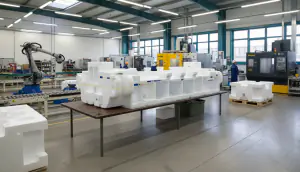
FOUNDRY MODEL MAKING
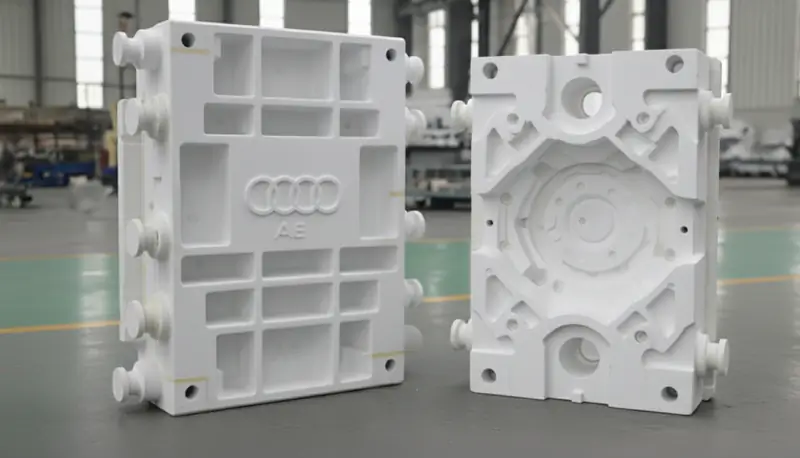
Evomatec Foundry Model Making – Precision, Technology, and Robotics for Perfect Casting Results
Innovation Meets Tradition in Industrial Model Engineering
Evomatec’s foundry model making combines decades of expertise in mold making with cutting-edge CNC machining technology and robotic automation. This powerful synergy delivers maximum dimensional accuracy, shorter production times, and outstanding repeatability for all industrial casting processes.
From prototypes and small batches to fully automated serial production, Evomatec develops customized solutions where precision, reproducibility, and durability are essential.
With Evomatec casting models, complex castings can be manufactured more efficiently, cost-effectively, and consistently at the highest quality. Advanced techniques such as 5-axis CNC machining, CAD/CAM design, reverse engineering, shrinkage compensation, robotic integration, and digital simulation are key elements of this approach.
The of Foundry Model Construction in Modern Industry
In industrial manufacturing, foundry model construction is far more than the creation of a mold — it is the core of the entire casting process. The precision and quality of the model determine the surface finish, accuracy, and dimensional consistency of the final casting.
A high-quality model minimizes rework, reduces scrap, and ensures production stability.
Evomatec integrates model construction as a systemic part of the entire production chain. By combining digital technologies, automated CNC machinery, and robot-assisted manufacturing systems, Evomatec achieves a new level of precision and cost-efficiency.
The integration of robotics, precision engineering, and intelligent process planning provides a competitive edge in quality, time, and cost, fully aligned with the Industry 4.0 Smart Factory philosophy.
Model Splitting and Mold Release – Perfect Separation for Smooth Casting
A key criterion in model construction is model parting, which defines how the model is divided into upper and lower mold halves for smooth demolding after casting.
Evomatec analyzes the ideal parting line during the design phase to prevent undercuts, distortions, and material tearing.
Technical Advantages
Precisely defined parting lines for flawless demolding
CAD-based simulation of mold separation
Inclusion of undercuts and mechanical ejectors
Adaptation to both machine molding and manual molding systems
This optimized design ensures reliable functionality, reduces maintenance needs, and extends the model’s lifespan significantly.
Shrinkage and Dimensional Accuracy – Precision Begins in Design
During cooling, every casting metal contracts — known as shrinkage. If not properly compensated, it leads to dimensional deviations or internal stresses.
Evomatec integrates shrinkage factorsectly into the digital CAD model. By calculating material contraction, each model is pre-dimensioned to ensure the final casting meets exact specifications.
Evomatec Shrinkage Compensation Advantages
Software-based calculation for all casting alloys
Automated dimensional adjustment in the CAD/CAM workflow
CNC precision within ±0.02 mm
Temperature compensation during machining
This results in dimensional stability far exceeding industry standards, a critical advantage for aerospace, automotive, and mechanical engineering castings.
Cores, Core Boxes, and Ejector Mechanics – Precision in Every Detail
Cores create the internal cavities and contours of the casting and require extremely precise manufacturing.
Evomatec produces core boxes and models with the highest precision — using CNC milling, additive manufacturing, or hybrid technologies.
Integrated ejector systems ensure safe, damage-free removal of cores and models. Intelligent spring mechanisms, pneumatic systems, and robot-assisted extractors minimize cycle times and extend mold life.
Technical Highlights
CNC-machined core boxes made from aluminum, steel, or composite resin
Polished cavities for precise form alignment
Automated ejector systems for robotic handling
Adaptable to molding and core-shooting machines
Material Selection – Strength, Longevity, and Cost-Efficiency
Depending on production requirements, Evomatec selects materials that balance durability, machinability, and cost efficiency.
From hardwood for small batches to metal molds for high-volume production, each material is chosen to withstand thermal and mechanical stresses.
Commonly Used Materials
Wood models: lightweight and ideal for prototypes
Resin and plastic boards (e.g., Ureol): high dimensional stability
Metal models (aluminum, steel, cast iron): robust and wear-resistant
Foam and hybrid models: suitable for rapid prototyping
With polished and sealed surfaces, these models guarantee exceptional surface quality and consistent performance even after hundreds of casting cycles.
Surface Finish and Coating – Perfect Casting Surfaces
The surface quality of a casting is determined by the finish of the model surface.
Evomatec ensures smooth transitions, precise radii, and polished textures, enhanced by specialized coatings that reduce wear and facilitate cleaning.
Surface Processing Advantages
CNC-finished, reproducible precision
Chemical and thermal sealing for durability
Minimal sand adhesion
Extended model lifespan
Superior casting surface finish
This level of refinement is particularly vital for aluminum, stainless steel, and gray iron castings.
Manufacturing Processes – From Craftsmanship to 5-Axis CNC
Evomatec combines traditional craftsmanship with state-of-the-art CNC machining.
Alongside manual finishing and grinding, 5-axis machining centers handle even the most complex geometries in a single run.
Manufacturing Techniques
CNC milling (3–5 axes)
Grinding and manual refinement
Wire and sink EDM
3D printing and additive manufacturing
High-speed cutting for fine surfaces
This hybrid approach ensures a perfect balance of automation and craftsmanship.
CAD/CAM Design and the Digital Process Chain
Every project begins with a digital 3D model. Using modern CAD software (SolidWorks, Siemens NX, Catia, Autodesk Inventor) and advanced CAM systems, Evomatec creates precise toolpaths and production data.
Shrinkage, undercuts, parting lines, and ejection systems are integratedectly into the design. This ensures that CNC production runs seamlessly with zero deviation.
Digital Workflow Benefits
Full traceability of model versions
Automated toolpath optimization
Simulation of thermal expansion and mold release
Direct robotic control integration
Reverse Engineering – Digitizing and Reconstructing Legacy Castings
Many foundries rely on older castings without existing digital models.
Evomatec’s reverse engineering service precisely scans, measures, and reconstructs parts using 3D scanning, photogrammetry, and laser measurement.
These data are converted into CAD models, optimized, and adapted for modern manufacturing.
This process enables reliable reproduction of historic, damaged, or undocumented castings.
Typical Applications
Reconstruction of machine components
Adaptation to new molding technologies
Serial reproduction without drawings
Digitalization for CAM production
Molding Boxes and Mold Construction – Precision in Every Interaction
The molding box integrates all essential components — model, core, ejector mechanics, and shrinkage compensation.
Evomatec designs boxes suitable for machine, hand, or shock molding, ensuring ergonomics, strength, and reusability.
Molding Box Technologies
Mechanically interlocked systems for serial casting
Quick-change mechanisms for flexible production
Integrated cooling and temperature regulation channels
Sensor-based monitoring and quality control
Fixtures and Assembly Aids – Accuracy and Alignment
Evomatec produces custom fixtures, jigs, and clamping systems for accurate assembly and measurement.
These ensure precision during handling, machining, and demolding — vital for robotic production environments.
Examples
Measuring fixtures for castings
Clamping systems for machining and mold extraction
Robotic grippers and automated alignment tools
Calibration aids for molding machines
Quality Assurance and Precision Measuring Systems
Quality control is an integral part of Evomatec production.
Each model undergoes 3D scanning, tactile measurement, and digital CAD comparison before approval.
Quality Systems
Optical and tactile measurement systems
CAD nominal/actual comparison
Temperature tracking during machining
Certified inspection reports (ISO 9001 & CE standards)
This ensures consistent, verified accuracy, regardless of batch size or complexity.
Temperature Management and Thermal Compensation
Thermal influences can distort model geometry.
Evomatec compensates thermal expansion through intelligent design, material selection, and active cooling systems.
Benefits
Stable geometry under variable conditions
Precisely defined tolerance zones
Extended lifespan and minimal maintenance
Prototype Model Construction – Fast, Reliable Development
For experimental casting and small series, Evomatec offers flexible prototype modeling using lightweight materials and additive manufacturing.
These allow functional testing, flow analysis, and fit evaluation before final production.
Prototype Services
Rapid development in a few days
CAD-based modification and optimization
Functional test casting and validation
Easy transition to serial production
Serial and Exchange Models – Efficiency in Mass Production
Evomatec designs modular serial and exchangeable models for high-volume foundries, enabling quick retooling and minimal downtime.
Features
High repeatability with identical output
Modular systems for fast changeovers
Robot-compatible interface design
Durable materials for thousands of cycles
Robotics and Automation in Foundry Model Construction
Evomatec integrates industrial robots, SCARA systems, Delta robots, and Cobots into the model-making and molding process.
These robots perform automated handling, assembly, core removal, and cleaning tasks with speed and precision.
Robotic Systems in Use
Articulated robots for flexible six-axis movement
SCARA robots for horizontal precision handling
Delta robots for high-speed pick & place
Cobots for safe human-robot collaboration
This integration combines traditional craftsmanship with the future of industrial automation.
Sustainability and Resource Efficiency
Evomatec’s modern foundry model production emphasizes sustainability and energy efficiency.
Through digital simulation, optimized toolpaths, and recyclable materials, waste and energy consumption are significantly reduced.
Industries and Application Fields
Automotive: Engine housings, suspension components
Mechanical engineering: Gearboxes, hydraulic blocks, structural parts
Aerospace: Precision aluminum and titanium castings
Energy sector: Turbine components, heat exchangers
Research and prototyping: Trial castings and small-batch production
Conclusion – Evomatec Foundry Model Construction: Precision in Every Dimension
Evomatec’s foundry model construction represents more than just mold manufacturing – it is a digitally driven, high-precision system for ensuring casting quality from start to finish.
Through robotic integration, CAD/CAM precision, shrinkage correction, and rigorous quality assurance, Evomatec sets new benchmarks in modern foundry technology.
Whether for prototype development, serial production, or fully automated casting, Evomatec delivers precision, reliability, and efficiency at the highest industrial level.
Contact our expert team: info@evomatec.de