 English
 German
 French
 Spanish
 Portuguese
 Italian
 Polish
 Turkish
 Romanian
 Greek
Greek
 Bulgarian
 Russian
 Arabic
 Hindi
Hindi
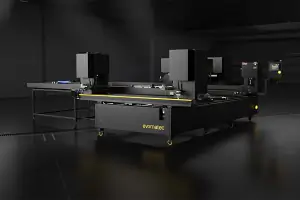
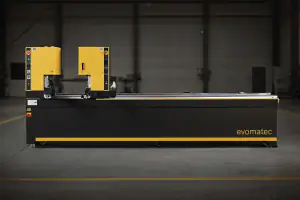
DOUBLE HEAD WELDING MACHINE EVOO IISN ECO PLUS
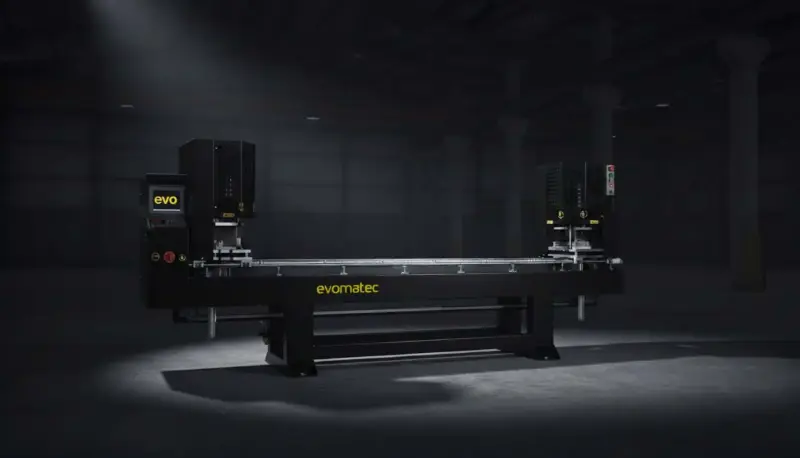
Speed, Quality, and Standardization in PVC Window and Door Production with a Double-Head Welding Machine - EVOO IISN ECO PLUS
In the PVC window and door sector, competition is no longer won only by price, but by consistency. Being able to produce hundreds of windows or doors in a single day with the same dimensions and the same aesthetics, keeping welding quality at the same level in every shift, and minimizing scrap all depend on the welding station at the heart of the production line. That is why, for modern workshops and factory lines, choosing a double-head welding machine is one of the most critical investment decisions.
In traditional single-station methods, operator skill and on-the-spot adjustments directly affect quality. By contrast, a high-automation double-head welding machine standardizes welding heat, time, pressure, and clamping. This ensures that dimensional accuracy and corner aesthetics repeat on every product. Especially in mass production, consistent weld quality on every piece reduces returns and installation issues, strengthens brand perception, and increases real profit.
The of Welding in PVC Window and Door Production and Why Double-Head Technology Stands Out
Corner joints in PVC profiles determine both the aesthetics and the mechanical strength of the product. Even the smallest gaps at the corners can later turn into problems such as water leakage, air leakage, color differences, and corner-angle distortion. That is why searching for a PVC corner welding machine and a PVC corner welding machine is, in reality, a search for quality.
With single-head systems, the production rhythm is usually limited by the operator’s part handling and cycle time. A double-corner welding machine approach that can weld two corners simultaneously or within a controlled scenario reduces production time while raising the quality standard. This means not only speed, but also process reliability.
Another critical advantage is compatibility with different profile types. PVC window profiles, door profiles, and sliding system profiles have different cross-sections and therefore different requirements for heat, time, and pressure. A PVC double-head welding machine solution with adjustable parameters removes the biggest bottleneck for companies working with a wide variety of profiles.
How a Double-Head Welding Machine Works
A PVC profile double-head welding machine and a PVC profile double-head welding machine basically operate in the following steps:
Cut PVC profile parts prepared with the appropriate tolerance are brought into the welding station
Profile ends are softened at the target temperature using the heating plate
When the heating time is complete, the plates retract and the parts are joined under controlled pressure
During clamping and cooling, dimensions are maintained and corner strength is formed
Weld beads are cleaned at the next station and the product becomes ready for assembly
Every step of this cycle is related to heat, time, pressure, clamping, and alignment. This is exactly where systems such as an automatic double-head PVC welding machine and an automatic double-head PVC welding machine with fully automatic control infrastructure come into play. Automation reduces human-driven variation and minimizes welding defects.
EVOO IISN ECO PLUS: A Production-Focused Double-Head Welding Solution
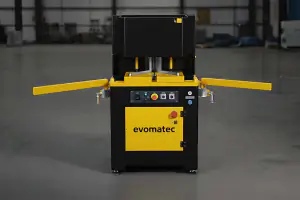
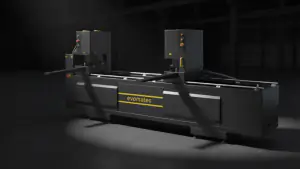
EVOO IISN ECO PLUS is positioned as a double-head welding machine solution for businesses that require high repeatability and a mass-production rhythm. The goal is a fast cycle, stable corner strength, and an operator-friendly control architecture. In a production environment where time is money, any slowdown at the welding station slows the entire line. Therefore, the EVOO IISN ECO PLUS approach aims to combine process reliability and ease of use in one solution.
This model is especially focused on manufacturers looking for a PVC window double-head welding machine and a PVC window double-head welding machine, aiming to increase both corner joint quality and production capacity together. In markets where profile variety is increasing, adjustable parameters target stable welding on every profile type.
Technical Specifications Table
| Technical Specification | Value / Description |
|---|---|
| Application | Designed to make corner welds on PVC profiles |
| Work safety | Fully safe against workplace accidents |
| Control type | Fully automatic control |
| Weld strength | Designed for maximum weld strength |
| Welding angle range | 90° welding on the right head, 30° to 180° welding capability on the left head |
| Operating mode | Single-head operation option |
| Motion system | The right head moves on sliding bearings |
| Locking | The movement is locked with the right-head knob |
| Maximum profile length | 3000 mm |
| Clamping | Top pistons have the option to clamp individually |
| Control system | PLC control system |
| Power supply | Power supply available |
| Parameter settings | Ability to set temperature, welding time, and pressure for different profile types |
| Monitoring | The temperature of the heating plate is displayed on the screen |
| Heating control | The heating unit has a thermostatic control system |
| Support | Profile support arms |
Production Performance: Speed, Repeatability, and Scrap Reduction
There are three main criteria that determine the return on investment of a double-head welding machine investment: cycle time, repeatability, and scrap rate. These three factors directly reflect in your production costs.
Cycle Time and Line Rhythm
In mass production, the welding station is often one of the key stops that determine the rhythm of the line. A double-head welding machine infrastructure aims to repeat the same process logic more steadily and in series. Especially thanks to automatic control, the operator does not lose time adjusting welding parameters. This results in a clear increase in daily output.
Repeatability and Quality Standard
Welding requires dimensional precision. Angles, profile seating, and pressure are areas where even millimetric deviations can make installation difficult. For this reason, PLC control on the PVC double-head welding machine side is not merely an “extra feature”, but a production standard tool. When the same profile is welded with the same parameters, corner quality becomes identical in every product.
Reducing Scrap and Lowering Return Risk
Corner defects mean rework, time loss, material waste, and customer dissatisfaction. An automatic double-head PVC welding machine approach with controlled parameter management helps maintain quality even with new operators. This reduces scrap and lowers post-shipment complaints and service costs.
Why the PLC Control System Is So Important
In today’s production world, the PLC is the “brain” of the machine. In the welding process, the main benefits provided by the PLC are:
Keeping the temperature stable
Controlling welding time and pressure in a repeatable way
Fast switching with a recipe logic according to profile type
Reducing operator errors
Making process tracking more transparent
That is why a solution such as a PVC double-corner welding machine with a PLC infrastructure, like EVOO IISN ECO PLUS, is a priority for businesses that want to protect their quality standard.
Welding Angle Flexibility: Applications from 30° to 180°
In the world of PVC window and door production, not every product has a 90° corner. Especially in architectural designs, special angled joints and different geometries are common. Therefore, the angle range stated in the image is a major advantage:
90° welding on the right head
30° to 180° welding capability on the left head
This flexibility increases the value of the investment for companies producing different product types. A PVC corner welding machine with the right angle capability helps you expand your product range and respond faster to special projects.
Maximum 3000 mm Profile Length: A Practical Limit for Workshops
The maximum 3000 mm profile length stated in the image offers an efficient working range in many production scenarios. This value is also important for line planning and space utilization. Especially in workshops with limited space, profile handling and placement ergonomics directly affect production speed.
With the EVOO IISN ECO PLUS approach, the goal is to maintain stable welding quality within this length range while making profile feeding processes easier for the operator.
Why Single-Head Operating Mode Is Critical
Production does not always run in an “ideal scenario”. Sometimes a one-off job arrives, sometimes one head must be taken out of operation for maintenance, or sometimes a special production step requires single-head use. That is why the “single-head operation option” is a flexibility and continuity safeguard.
This feature is a criterion that should not be overlooked when buying a double-head welding machine. Because production continuity is often protected through instant flexibility.
Mechanical Motion and Stability: Movement on Sliding Bearings
The statement “the right head moves on sliding bearings” in the image is an indicator of mechanical stability. Smooth motion positively affects profile alignment and pressure application. This can create a direct difference in corner aesthetics and weld strength.
In addition, the item “the movement is locked with the right-head knob” strengthens operator adjustment safety and process repeatability. In production, an adjustment shift creates defects. Locking helps prevent defects.
Heating Unit and Thermostatic Control: The Foundation of Welding Quality
In PVC welding, the right temperature is as important as the right time. Temperature fluctuation can cause one corner to melt too much and lose shape, or cause insufficient fusion and reduced strength. That is why a thermostatic control system is the foundation of welding quality.
Two critical points stand out in the image:
The temperature of the heating plate is displayed on the screen
The heating unit has a thermostatic control system
These two items increase process transparency. The operator can see whether the temperature is at the target. This accelerates both quality and the training process.
Adjusting Heat, Time, and Pressure for Different Profile Types
In a production line, different profile series may be processed on the same day. Different wall thicknesses, different compound ratios, and different surface finishes affect welding parameters. Therefore, the item “ability to set temperature, welding time, and pressure for different profile types” stated in the image is highly valuable.
This flexibility is among the main topics that businesses searching for a PVC profile double-head welding machine pay the most attention to. Because as profile variety increases, adjustment capability determines production efficiency.
Individual Clamping of Top Pistons: Controllable Pressure
In corner welding, clamping preserves the joint geometry of the parts. The ability to clamp the top pistons individually helps manage pressure in a more controlled way. This makes it easier to achieve more stable results, especially with different profile shapes or special geometries.
Profile Support Arms: Ergonomics and Error Reduction
Profile support arms increase operator ergonomics and alignment accuracy. Profile sagging can negatively affect the welding angle and joint quality. Thanks to the support arms, the part is carried and positioned more stably. This is one of the factors that practically improves the performance of a PVC window double-head welding machine.
Buying Perspective: Price, Promotions, New and Second-Hand Options
Users searching in the market usually act with direct buying intent. That is why the following expressions often stand out in search trends: double-head welding machine price, PVC double-head welding machine price, double-head PVC welding machine price, automatic double-head PVC welding machine price, double-head welding machine for sale, PVC double-head welding machine for sale, used double-head welding machine, second-hand double-head welding machine, new double-head PVC welding machine, double-head PVC welding machine promotion.
These searches show that users are looking for answers to three main questions:
Which level is suitable for my production capacity
Is new or second-hand more advantageous
Does the quality the machine provides justify the price difference
When evaluating a solution such as an automatic double-head PVC welding machine like EVOO IISN ECO PLUS, you should consider not only the initial purchase cost, but also its potential to reduce scrap, increase speed, and reduce service and downtime. Because the real cost often comes from production stoppages and defects.
How to Choose the Right Double-Head Welding Machine
When choosing a double-head welding machine, moving forward with the following criteria reduces investment mistakes.
1) Profile Variety and Product Type
Window, door, sliding, or special angled work. Your product type determines angle capability and the parameter range.
2) Daily Production Target
How many frames, sashes, and outer frames per day. This target determines the necessity of the automation level.
3) Control System and Ease of Adjustment
PLC control and parameter monitoring via the screen are the key to keeping quality stable.
4) Mechanical Stability and Ergonomics
Smooth motion systems, locking, and profile supports reduce operator errors.
5) Service, Spare Parts, Training
No matter how good the machine is, production continuity is protected by service speed. Training and technical support are the safety layer of the investment.
Integration into the Production Line: A Welding Machine Is Not Considered Alone
In modern PVC window and door production, welding is one link in a chain. Cutting, milling, reinforcement placement, welding, corner cleaning, assembly, quality control, and packaging must be planned as a whole. Therefore, when investing in a PVC double-head welding machine, line flow and material logistics must also be considered.
With the right layout, operator walking distance decreases, profile handling times shorten, and daily capacity increases. This provides a direct cost advantage.
Quality Control: What to Check After Welding
An effective quality control routine makes welding quality sustainable. The post-weld checklist should include the following:
Whether there is any gap in the corner joint
Corner aesthetics and symmetry
Standard cleanability of weld beads
Dimensional accuracy and angle retention
Periodic sample tests for strength control
At this point, automatic double-head PVC welding machine systems with parameter traceability make quality management easier.
EVOO IISN ECO PLUS Product Information: Who It Is the Right Choice For
EVOO IISN ECO PLUS is a strong solution especially for the following business profiles:
PVC window and door manufacturers with high daily output
Workshops that process different profile types and need parameter adjustment
Companies that want to keep the quality standard even if operators change
Manufacturers that define corner strength and aesthetic appearance as a brand criterion
Businesses that want to secure line continuity with flexibility such as single-head operation
As a PVC corner welding machine, this model targets continuity and standardized quality in production. At the same time, for users expecting a PVC double-corner welding machine, it highlights the speed and stability advantage brought by the two-head logic.
The Right Welding Investment Takes Your Production to the Next League
Growing in the PVC window and door sector is not only about selling more, but about producing in a more controlled way. The more your production processes are standardized, the more stable the quality becomes. As quality becomes stable, customer satisfaction and the referral effect increase. At the center of this chain is a correctly selected double-head welding machine.
As indicated by the technical items in the image, EVOO IISN ECO PLUS brings together production-critical elements such as automatic control, wide angle capability, 3000 mm profile working capacity, adjustable heat-time-pressure management, thermostatic heating control, and PLC infrastructure. If your goal is to produce faster, more repeatably, and with less scrap, the right welding solution directly increases the performance of your line.